

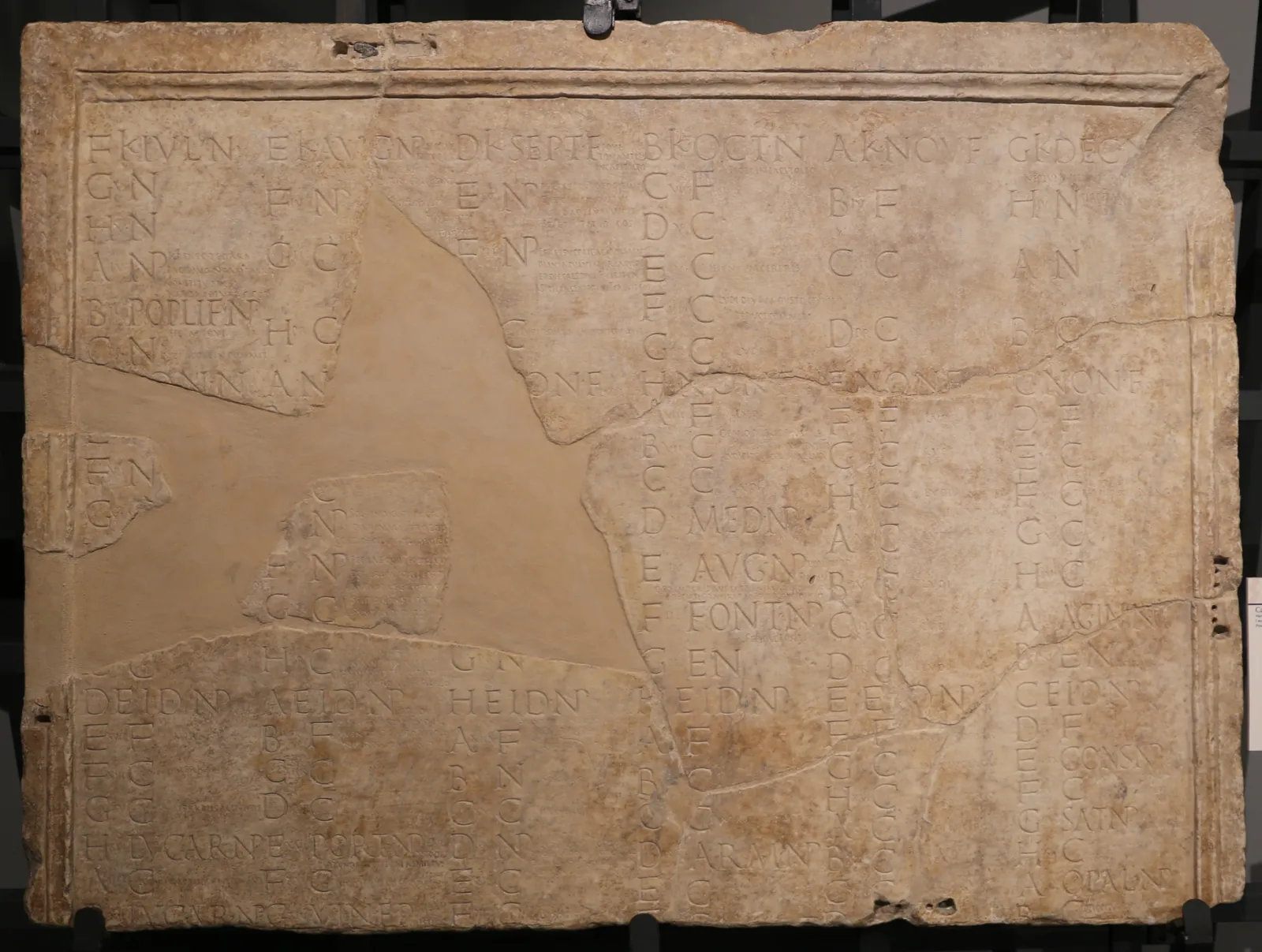
on the capitol, on 9 october, rome offered a sacrifice to good luck. luck itself was the goddess, with a cult of her own and a fixed day in the calendar. not a single scene of that rite has come down to us. no ancient source says what was sacrificed, who officiated or why on that day. what remains is a calendar entry, and it is best to read first what the stone says and then what has been laid on top of it.
the entry exists twice. the fasti of the arval brethren, a marble calendar of the augustan age kept by that college of priests, record at 9 october: genii publici, faustae felicitati, veneri victrici in capitolio, apollini in palatio. and the fasti amiternini, carved around 20 ce at amiternum, in sabine country, repeat the entry almost word for word — genio publico, faustae felicitati, veneri victrici in capitolio, apollini in palatio — and add ludi, games. to the public genius, to fausta felicitas and to venus victrix on the capitol; to apollo on the palatine.
the day also carries two letters. one is the market letter: the roman week had eight days marked a to h, and 9 october gets the b. in the arval copy that letter is restored by the editors, but the cycle fixes it: the entry for 1 october, eight days earlier, keeps the same b. the other letter classifies the day, and the amiternum calendar preserves it: c, comitialis, a working day on which the people could be summoned to vote. it was not a feria. in these calendars the status of the day goes in large letters and the cult notes in small ones, so the entry is a sacrifice added on top of a working day.
everything else is modern reading, and it is worth saying so piece by piece. that in capitolio governs all three names and not only venus’s is everyone’s interpretation, but it is interpretation. that there was a shrine or an altar of the genius there is an inference: platner and ashby write that there «probably» was. whether the three shared a shrine or each had its own is not settled, but they themselves lean one way: «the second hypothesis is the more probable». the dispute is still open in the literature: degrassi and cenerini infer from the entry a shrine of the genius’s own on the capitol; palombi holds that it only proves he received cult there alongside other deities. a sacrifice calls for an altar, and the entry places the rite on the capitol: that is as far as the evidence goes. a temple of his own, no. that 9 october is the anniversary of the temple of apollo on the palatine, dedicated by octavian in 28 bce, is a deduction from these same calendars: cassius dio gives the year and not the day. and the ludi at amiternum do not say whose they are: nothing in the entry ties them to the genius or to apollo.
the sacrifice on the capitol stayed in its calendar entry, faceless. the genius on the street corner already had the face of the man in charge.
a genius, in rome, was a personal god. censorinus defines it as «the god under whose protection each person lives from birth», and adds that it accompanies us without leaving «for a moment», from the mother’s womb to the last day. «every roman had one» is the short version: seneca recalls that the ancestors gave each person a genius and a juno, and the usual reading assigns the genius to the man and the juno to the woman, and censorinus records that they already argued about the number: some gave two genii to the houses of married couples, and euclides the socratic, two to everyone.
rome gave one to the whole people. the public cult of a genius is old: in the winter of 218 bce, in the round of expiations that followed the disaster of the trebia, livy records that «to the genius five greater victims were sacrificed», and most specialists read there the genius of the roman people, or the public genius. that says nothing about the triad of 9 october, which we know only from two calendars of the imperial age — in the painted calendar of antium, older than caesar, the entry for that day does not survive —, but it rules out presenting the collective genius as an invention of the empire.
that the genius publicus of the calendar is the genius populi romani of the coins is an identification many specialists accept, resting on the fact that publicus is formed on populus. mind who is saying it: the commentary in judaism and rome that sets out that identification argues in the very next breath the opposite, that the public genius is «not exactly» that of the roman people, because in ammianus it protects the emperor. and it warns that no image of the genius publicus survives on coins or reliefs: the cornucopia and the patera belong to the genius of the roman people. ammianus, more than three centuries after the calendar entry, has the public genius appear to julian in gaul «in the form in which it is usually represented», and again, shortly before his death, leaving his tent with its head and its horn of plenty covered by a veil.
beside him, two successes turned into goddesses. fausta felicitas is luck that turns out favourable; venus victrix, the one who grants victory. careful with the latter: the famous venus victrix is the one of pompey’s theatre, dedicated in his second consulship, in 55 bce, according to pliny, with its anniversary on 12 august, when the same arvals record venus victrix, honos, virtus and felicitas, among others, in theatro marmoreo. it is the temple that tiro, cicero’s freedman, describes in aulus gellius as the one «whose steps served as a theatre». the one on the capitol is known only from the entry of 9 october.
the genius of the roman people also had a shrine in the forum, which cassius dio mentions twice, both times as the scene of portents: vultures perched on it and on the shrine of concord in 43 bce, and an owl that in 32, on the eve of actium, ended up perching on it. dio does not say where it stood: «in the forum, near concord» is what platner and ashby deduce from that proximity and from other clues. of the capitol, dio says nothing.
and ovid provides the close, already under augustus: the city, he writes, has a thousand lares and the genius of the leader who gave them to it, and the neighbourhoods worship three divinities. the small gods of the crossroads already had at their side the genius of a man with a name of his own.