

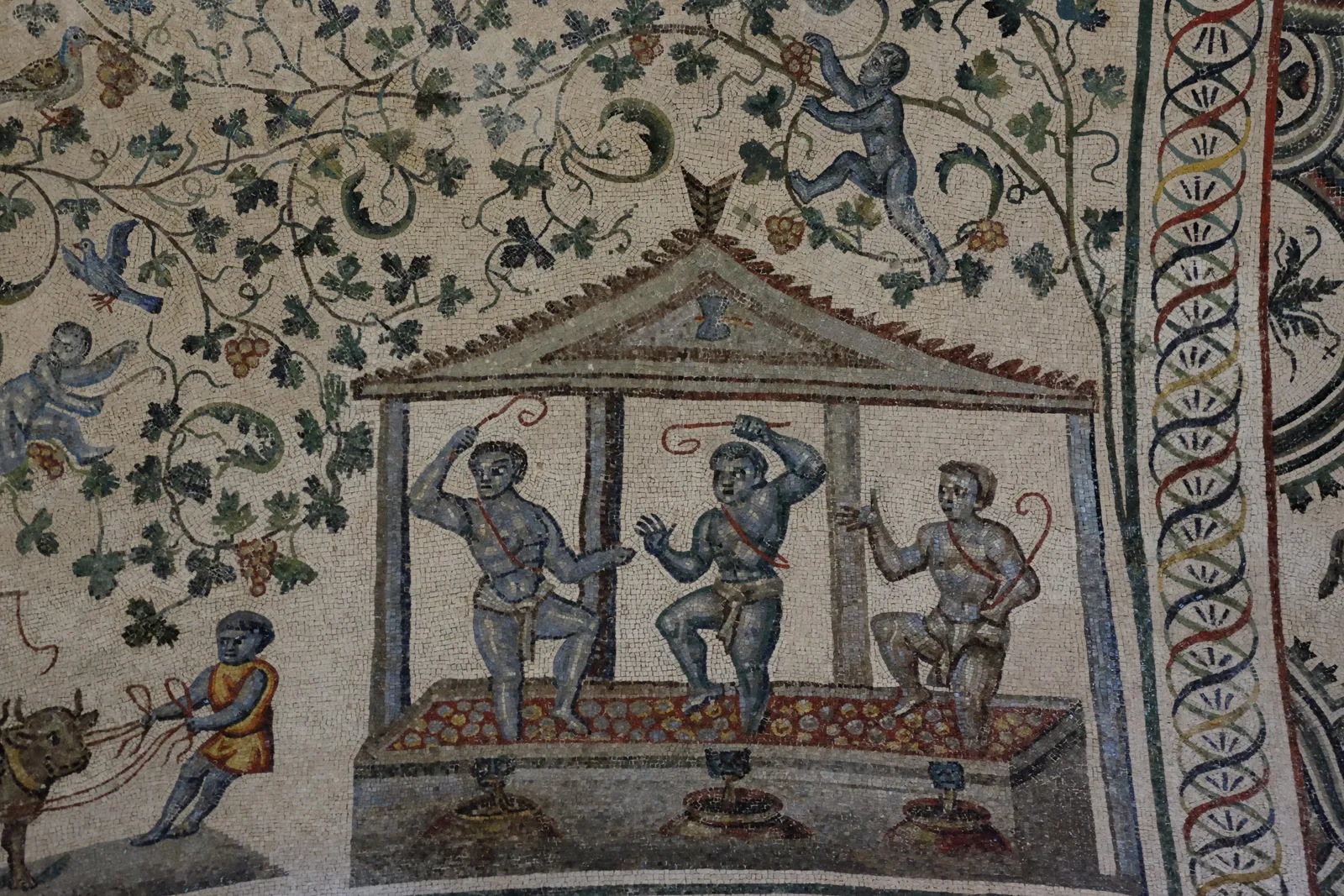
«i drink new and old wine; i heal new and old sickness». that is what many people said when tasting the year’s wine in rome, according to varro, who records it in his treatise on the latin language. the day was 11 october, the meditrinalia, and the phrase is half the content of this festival: out of it came, in the course of time, a goddess.
the translation matters. in latin it reads novum vetus vinum bibo, novo veteri morbo medeor. «new and old» goes with the wine, which is what is drunk; «new and old» goes again with the sickness, in the dative, because the verb medeor, to heal, takes the dative. new and old wine against new and old ill: that symmetry is the charm of the formula, and it is lost if one translates «with the new and the old i heal myself». there are editions of varro that insert a second vino into the second half and would allow that reading, but the independent version preserved in the summary of festus does not have it, and it looks like a copyist’s repetition of the preceding vinum.
that second version, moreover, reverses the order: vetus novum vinum bibo, veteri novo morbo medeor, old and new instead of new and old, in both halves. two different orders for the same formula are what one would expect of something passed from mouth to mouth.
varro’s passage does three things in one sentence, and only one of them does he owe to his informant. the etymology is his own: the meditrinalia are so called a medendo, from healing. the rite was told to him by flaccus, the flamen of mars, one of the three major flamines: that on that day it was customary to pour a libation of and taste new and old wine medicamenti causa, as a remedy. and the formula varro puts in his own voice and in the present tense: it is something that «many still do today when they say» those words. this flaccus is not to be confused with verrius flaccus, the augustan-age scholar whose dictionary festus summarised.
nor does varro say everything attributed to him. he does not speak of mixing the two wines: mixing in a cup is suggested by the formula, but he says to pour and taste new and old wine. and he does not say must, nor «for the first time». that comes from the summary of festus, which is another matter: there the custom belongs to «the latin peoples» in general, it was done «on the day on which one first tasted the must», and the phrase was said «for good omen», with no calendar date. that 11 october marked the end of the grape harvest and the first tasting of the young must is wissowa’s synthesis; the beginning of the grape harvest, he recalls, had no fixed date. it was opened, varro says, by the flamen of jupiter: he sacrificed a ewe lamb and, between the cutting out of the entrails and their offering, gathered grapes himself.
«from those words the name of the goddess meditrina was also conceived». conceived: the very source that invents the goddess confesses where it got her from.
in that summary the festival already has an owner: «from those words the name of the goddess meditrina was also conceived, and her rites were called meditrinalia». the chain is verrius flaccus, festus and paul the deacon, and we keep only the last link; if the entry comes from verrius, the goddess is an inference of the augustan age, a generation after varro. nothing more is known of her: not a temple, not a priest, not an inscription. fowler wrote that there is no real evidence for a goddess meditrina, and wissowa, that she never existed «anywhere but in the heads of some speculative grammarians». no ancient source calls her a goddess of health, of wine or of longevity, as many mythology pages repeat today.
because the day was not hers. the soundest evidence is that of the calendars. the painted calendar of antium, the only one older than caesar’s reform that survives, already has meditrinalia on the 11th with the mark np, that of the great festival days, and three stone calendars of the imperial age repeat it. one of them, that of amiternum, adds two words: feriae iovi, festival of jupiter. in that of the arval brethren the entry for 11 october is edited with the same name and the same rubric, but of the name not one letter survives and of the rubric barely two: the rest is restored by the editors. from this mommsen and wissowa concluded that the day’s owner was jupiter, as in the other two wine festivals of the calendar, the vinalia of april and of august. that series is a modern synthesis, not an epigraphic reading: the jupiter rubric of august is in another calendar, that of allifae, and that of april rests on varro, who writes of the vinalia: «this day is jupiter’s, not venus’s».
the ancient explanation goes from the phrase to the goddess and from the goddess to the day; the reading of fowler and wissowa reverses it: the goddess was deduced from the name of the festival. the name itself still has no firm explanation. varro’s etymology, a medendo, has found no replacement: ernout and meillet record it under medeor and merely reproduce it, and de vaan does not list the word. the only modern proposal, by h. ehrlich in 1910, connected it with the root of the fermented drink, that of mead; wissowa cites it in a note and it has not reached consensus.
what does hold up is the root of medeor. from it come medicus, medicina, remedium: physician, medicine, remedy. de vaan traces it to an indo-european root that meant «to measure», and explains the sense of healing as a later shift; ernout and meillet gloss it as «to think», with «to measure, to weigh, to judge» and «to care for a sick person» among its technical values. that before naming the cure the root named the measure is de vaan’s reading; it fits within ernout and meillet’s, who do not put it first.