

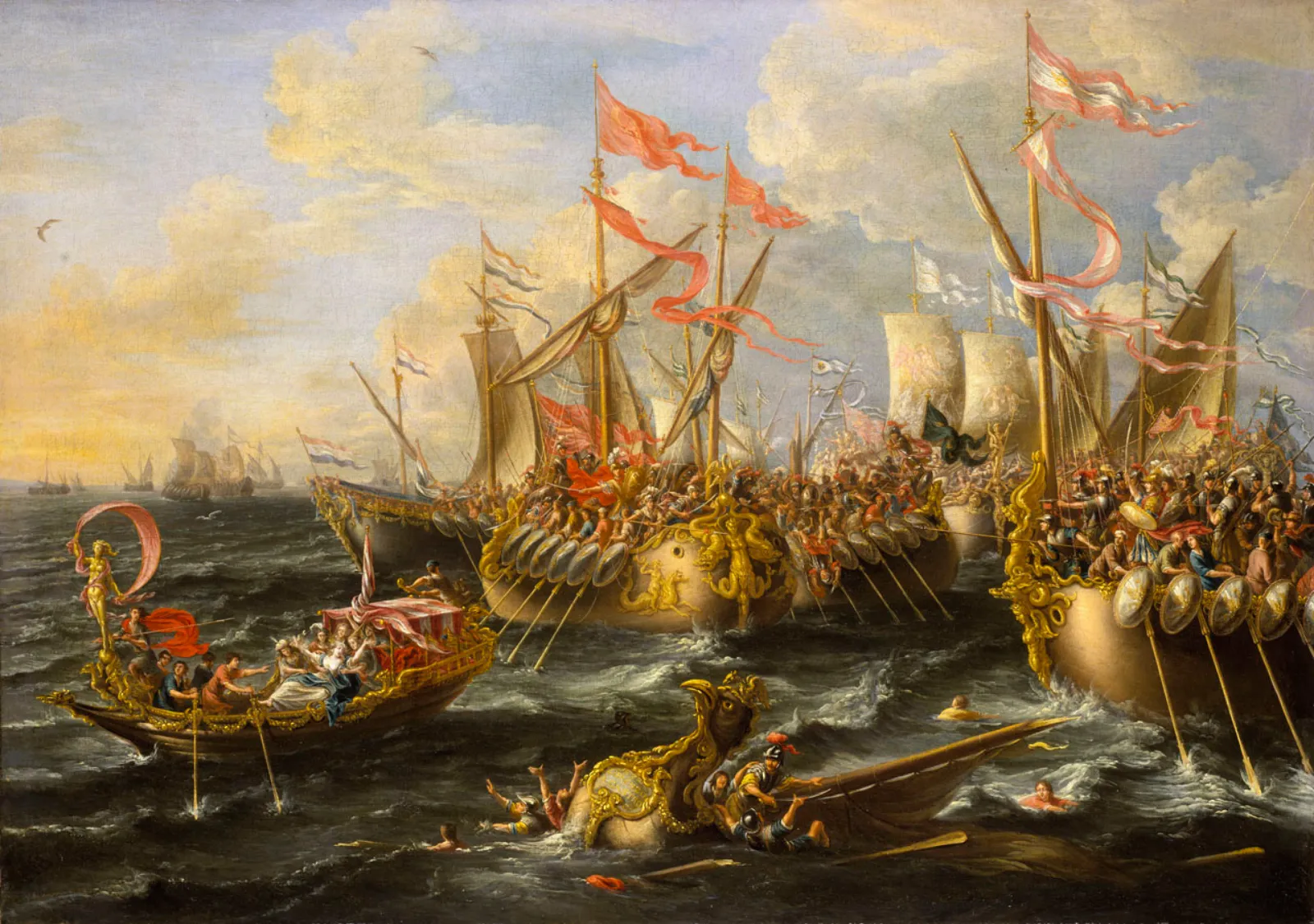
the battle that decided who would rule the roman world lasted a single afternoon, and what settled it had happened months earlier. it was 2 september of the year 31 before our era, off the promontory of actium, at the mouth of the ambracian gulf. cassius dio, writing two and a half centuries later, stops at the date and explains why: from that day caesar —still octavian— held all the power alone for the first time, «and for that reason the years of his reign are properly reckoned from then».
the blockade is not in plutarch: it is in dio. agrippa, octavian’s admiral, took methone and set about hunting antony’s supply ships; leucas, patrae and corinth fell next. inside the gulf the crews had been thinning «through disease and desertions», and grain began to run short because there was no longer any way to bring it in. the human detail is plutarch’s: the captains were pressing rowers from among wayfarers, mule-drivers, harvesters and ephebes. canidius, who commanded the legions, asked antony to send cleopatra away and withdraw into thrace or macedonia to settle it on land. antony paid no attention.
dio does report a council of war in which cleopatra’s view prevailed: leave garrisons behind and sail to egypt with the rest. they burned the ships they could no longer man, loaded the valuables aboard by night and put out «neither secretly nor openly, as if in flight», but as men preparing to fight. and the material detail is plutarch’s: antony had the sails taken on board, which in a naval battle were left ashore. the fighting was still «undecided and even» when cleopatra’s sixty ships hoisted sail and made for open water. antony jumped into a five-banked galley and followed her. for plutarch he went «dragged along by the woman as if he had become part of her body»; for dio, the queen could not endure the waiting, «true to her nature as a woman and an egyptian».
that afternoon octavian took the sea. what he really carried off was the right to tell what had happened on it.
now the historiographical nuance, which is worth not skipping. reading the sortie as a planned manoeuvre —break the blockade, save the war chest— begins in the late nineteenth century with kromayer and runs down to goldsworthy, who takes it as premeditated on the evidence of the sails and the money aboard. but the debate is still open: in 2011 carsten hjort lange reopened it in classical quarterly. every ancient source but one has antony fighting for victory until cleopatra left; the sails and the treasure would be the emergency exit, not the plan. the one that dissents is, precisely, dio with his council of war: the planned manoeuvre is not a modern reconstruction against the ancient sources, it is one ancient source against the others. what nobody disputes is the blockade, the fevers and the desertions.
what was left behind surrendered without a fight. plutarch puts the dead at no more than five thousand and the captured ships at three hundred, «as caesar himself has written»: the figures for actium come out of the victor’s memoirs. the nineteen legions and twelve thousand horse on land held out for seven days, until canidius fled by night and the men, «betrayed by their commanders», went over to octavian: dio has them overtaken without a battle on the road to macedonia. eleven months later, on 1 august of the year 30, octavian entered alexandria. antony killed himself believing cleopatra dead, and she when she learned she would be shipped to rome to walk in the triumph. suetonius says he wanted her alive for exactly that and had psylli brought to suck the poison out.
the version that prevailed was sung by the poets before there was any written history. virgil engraved actium on the shield of aeneas: augustus with the senate and the great gods; opposite him antony with «barbaric wealth», his «egyptian wife» and «the barker anubis» against neptune, venus and minerva. the poem grew under augustus’s patronage; whether there was a direct commission is disputed, the effect is not. velleius paterculus also deserves putting in his place: from him comes «the commander whose duty it was to punish deserters, turned deserter from his own army». he was born twelve years after the battle and wrote under tiberius, around the year 30 of our era. it is the oldest prose account we have, not an eyewitness. syme said it without anaesthetic: actium was «a shabby affair, the worthy climax to the ignoble propaganda against cleopatra».
octavian then did what is done with a battle one wants remembered as such: he founded quadrennial games and a new city, nicopolis, «the city of victory». where his tent had stood he raised a platform of squared stone set with the captured rams; suetonius adds that he consecrated the camp to neptune and mars, and the inscription on the wall confirms it: «peace secured on land and sea». the sockets of at least thirty-six rams are still in the stone, and that is the imagery paul zanker later traced through coins and temples. nobody builds a wall of trophies to commemorate a siege. four years later, in january of the year 27, the senate gave him the name we know him by: augustus.