

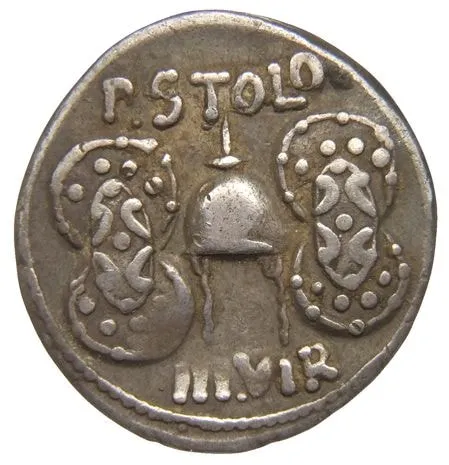
the roman calendar has two days with the same number seven months apart: 19 march and 19 october. in the roman count they also bear the same name — the fourteenth day before the kalends of april and the fourteenth before those of november —, and on both there is word of the same sacred shields. the second was called the armilustrium, the purification of arms.
no literary source gives the date. varro puts the armilustrium in his batch of october festivals without saying which day, and the epitome of festus does not say either. the 19th comes from epigraphy: warde fowler, in 1899, headed it with the mark np and the abbreviation arm, and warned that in the calendars only those first three letters appear. that count has a date: all the stone calendars fowler worked with were of the augustan age or later. the only one older than caesar’s reform, painted on stucco at antium, was found in 1915, and in warmington’s translation its 19 october keeps the festival-day mark, but the name of the festival stands in square brackets: restored by the editors. degrassi’s epigraphic edition has not been checked here.
the two ancient descriptions say different things. varro explains the name: the armilustrium is so called because in the armilustrium they perform the rites under arms — «unless the place takes its name from them» —, and he derives it from ludere, to play, or from lustrum, purification, «because they went round playing, armed with the ancilia». two caveats: varro does not decide whether the festival gave its name to the place or the other way round, and the form «to play» is a modern emendation, because the manuscripts have luendo, from luere, to expiate. the epitome of festus, a summary of a summary of the dictionary of verrius flaccus, gives the other: it was a festival at which they performed the rites under arms and, while they sacrificed, sounded the trumpets. it names neither the salii nor the shields.
the place is not settled either. livy says that in 207 bce «it seemed to rain stones in the armilustrium» and the nine-day rite had to be repeated: it is the oldest datable mention, and it is of the site, not of the festival. platner and ashby put it on the north-west slope of the aventine, probably south of santa sabina, beside the vicus armilustri cited by three inscriptions; fowler read in varro «the aventine, near the circus maximus», on the other side of the hill, and confessed he could find no explanation. no remains survive.
the ancilia were the sacred shields of mars, and the salii carried them. dionysius of halicarnassus says that numa appointed twelve patrician salii, and that of the many shields they carried only one had fallen from the sky: the rest were made identical so that a thief would not know which it was. ovid says numa had «more» made, not twelve. and there is an episode that shows the weight of those days. in 190 bce a roman army on its way to asia camped on the hellespont, writes livy, «because the days on which the ancilia are moved had happened to fall», and publius scipio, being a salius, was kept apart from the army on those days. polybius gives the rule: the salii, wherever they are, may not change their residence for thirty days while the sacrifices last. neither of the two says in which month.
the symmetry is not an ancient datum: it is a reading of the calendar. well established, probably correct, and with an author.
the bridge between the two dates is two sentences. a note in the augustan calendar of praeneste, attributed to verrius flaccus, says that on 19 march the salii danced in the comitium, with the pontiffs present according to the restoration of the stone; and a late grammarian, charisius, writes that on that day «the arms, the ancilia, used to be purified». his etymology is false, fowler admitted, but the reason he gives is valuable. the rest is interpretation. the symmetry was proposed by georg wissowa in 1891 and taken up by fowler in 1899, with the note that mommsen disapproved of wissowa’s reasoning and with a caveat of his own: the object and meaning of the purification, he wrote, are not entirely clear, and one is tempted to suppose that it stood for that of the arms of the whole army. wissowa gave it its mature form in 1902: the ritual terms ancilia movere and ancilia condere would symbolise taking up and laying down arms, and the parallelism of the two cycles, he wrote, «leaps to the eye». no surviving ancient source says that rome closed its military year on that day.
a warning about the text usually cited in support. suetonius says that otho set out on campaign with the ancilia «moved and not yet put away», something held to be ill-omened since ancient times; tacitus uses the same verb. but otho left rome, according to tacitus, on the eve of the ides of march of 69: the passage documents the march cycle, not a ban on war running from march to october.
what can be checked is the gap left behind. fowler wrote that from 19 october there was no festival of mars until the new year, 1 march, and that is not accurate: the equirria of 27 february, horse races on the campus martius, belong to mars, wissowa himself counts them among his spring festivals, and the calendar of antium preserves the beginning of the name, equ[irria]. what is empty is november, december and january. rome’s oldest year began in march — varro counts the months from it, which is why september still means «the seventh» —: the god of war came back to the calendar in the month rome went back to counting.
nor should the march rites be merged. varro explains the quinquatrus of the 19th as a date name, «the fifth day after the ides», and complains that through a mistake over the name it is celebrated as if it were five days; the tubilustrium of the 23rd, the purification of the sacred trumpets, is another festival. and the march half survived better than the october one. in the calendar of filocalus, of the year 354, 9 march still reads ARMA ANCILIA MOVENT, the 19th QVINQVATRIA — in the plural: varro’s mistake won — and the 23rd TVBILVSTRIVM. 19 october no longer says armilustrium: it says games of the sun, and the sun in scorpio.