

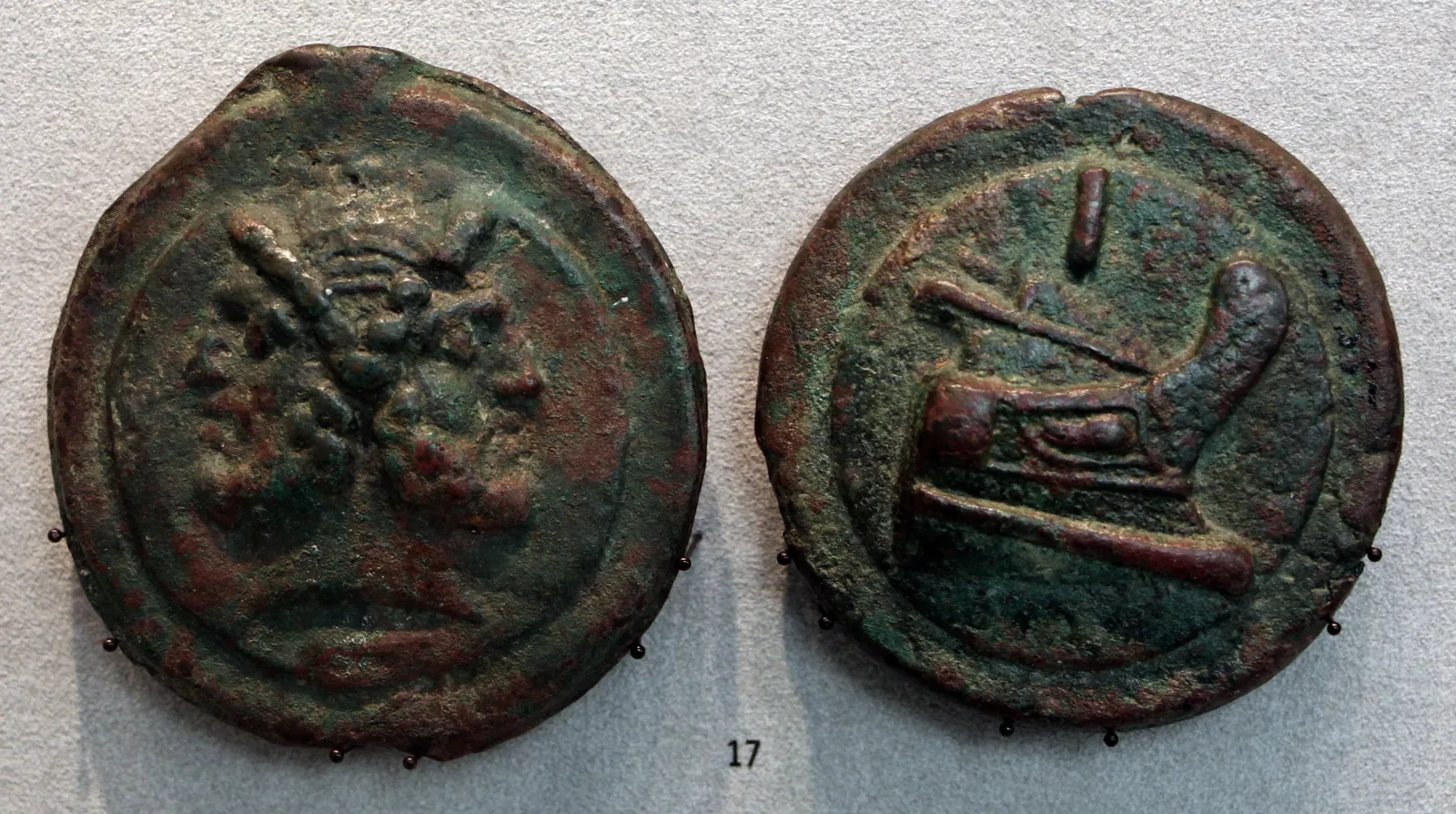
in a sloping street that ran down from the carinae, on the slope of the oppian, a wooden beam crossed overhead. it held nothing up. the romans called it the tigillum sororium, the sister’s beam, and the state went on repairing it at public cost. the calendar kept a day for it: 1 october.
no historian gives the date. livy and dionysius of halicarnassus tell the story, but neither says on what day the rite was performed; dionysius writes only that the place received sacrifices every year. the day comes from the stone: the fasti of the arval brethren, a marble calendar of the augustan age, record on the kalends of october fidi in capitolio, tigillo sororio ad compitum acili, to fides on the capitol and to the sister’s beam by the crossroads of the acilii. the editions do not wholly agree on which letters of that line survive and which are restored, but they do agree on the reading, which fowler was already printing in 1899. and for the beam the entry gives a name and a place: neither janus nor juno, nor a rite, nor horatius. the painted calendar of antium, older than caesar’s reform, records fides on that same day and does not mention the beam.
the story that explained it is that of the third horatius, the survivor of the combat against the curiatii, who on his return killed his sister for mourning one of the dead enemies, her betrothed. the duel, the crime and the trial are told in the encyclopædia entry on the duel that changed rome, and what is said there still holds here: the judicial chain — the duumvirs who condemn him for perduellio, the appeal, the acquittal «more in admiration of his courage than for the justice of his cause» — is the version rome gave of the origin of its own provocatio ad populum. dionysius goes so far as to claim it was the first time the people judged a capital case. these are the sources’ claims about their own institutions, not independent data.
what matters for the beam is what came afterwards. in livy, the king orders the father to expiate the son with public money, pecunia publica; the father performs certain expiatory sacrifices, which were afterwards left in the charge of the gens horatia, lays a beam across the street and makes the young man pass beneath it with his head covered, «as under the yoke». in dionysius, by contrast, the king calls the pontiffs, who purify horatius with the rites used to expiate involuntary homicides, raise two altars and pass him under the yoke. and festus, who preserves a third, badly mutilated version, says the beam rested on two posts the father had set up. three accounts, two agents. in livy, moreover, the beam is laid in that very act: that the object was older than the story is a modern reading, not what the source says.
the story is literary; the day is epigraphic. and the story cannot even agree on the object it explains.
because the beam itself has two incompatible ancient descriptions. dionysius, who was writing in rome in the time of augustus, describes it fixed into the two opposite walls of the street, above the heads of those who came out of it. festus speaks of duo tigilla tertio superiecto: two timbers and a third on top, which is exactly the shape of the yoke as livy himself gives it in another passage, three spears, two driven into the ground and the third tied across. a beam set into walls needs no posts. the usual reconstruction — platner and ashby define it as a crossbar on two posts — follows festus; fowler, by contrast, kept to the wall-to-wall beam and for that reason could not see why it should be explained as an arch of janus.
something similar happens with the altars. dionysius has two: one to janus, who was given the surname curiatius for the dead curiatii, and another to juno, «to whom the care of sisters belongs». that is a periphrasis, not a title. the two cult epithets together, janus curiatius and juno sororia, are given by festus and by the bobbio scholiast on cicero: «two altars having been raised to janus curiatius and to juno sororia, and a beam laid over them, horatius was passed under the yoke».
what was it, then? modern scholarship has not agreed. platner and ashby collect five proposals: a gate of the early settlement on the esquiline, a gate under which the army purified itself on returning from campaign, a gate of the septimontium, an ianus or street passage tied to the two altars and to the cult of janus and juno at the start of the month, or a simple fetish. fowler thought the beam «really inexplicable» and suggested that the cult titles may have given rise to the legend. someone also read sororia from the verb sororiare, which the same lexicon of festus records for the breasts of girls when they begin to grow, and turned juno sororia into a goddess of puberty; dumézil called that use «extravagant».
dumézil, on the other hand, thought the annual ceremony was «really, as tradition claims», the continuation of a purification rite for the returning warrior, belonging to the gens horatia and at the same time of public use, and he fitted it into the october cycle of mars, which for him closes the war season. it is best not to make him say more: in the same work he holds that the story of the horatii reproduces a myth of the warrior god indra, that is, that the tale was already a myth turned into history. what he rejects is something else: the thesis that the legend was manufactured from the names of monuments that already existed. and he counts the rite among the fixed festivals of the year: the kalends of october are one of only three kalends with a festival.
public money appears twice in livy, and they are two different facts: it pays for the expiation, and it keeps paying for the repair of the beam. id hodie quoque publice semper refectum manet, he writes: it is still there today, always repaired at public expense. dionysius adds a third expense that he attributes to the same episode, a law still in force in his day by which the treasury paid for the rearing of triplets. of the beam no remains have been securely identified. the last known mention is in the fourth-century catalogue of the regions of the city, in the region of the temple of peace. of the rite we know almost nothing; of the expense, on the other hand, livy left a record in a bookkeeper’s sentence. in rome, what went on being paid for was what went on mattering.