

no joining battle, no raising troops, no taking the army out on campaign, no casting off, no marrying to have children. three days a year rome refrained from all of that, and one of them was 5 october. the reason was a sacred place called the mundus, which stood open on those days. what exactly it was, how it was opened and where it stood are three questions the sources leave unanswered.
the list of prohibitions is varro’s, but we do not read it in him: macrobius preserves it, in the saturnalia, almost five centuries later. macrobius explains that there are three occasions on which battle is not joined — the latin festival, the saturnalia and the days on which the mundus is open —, says that the mundus is consecrated to dis pater and proserpina and that it seemed better to go to war with the jaws of pluto shut, and quotes varro: «when the mundus is open, it is as if the door of the gloomy gods and of those below were open». the four abstentions follow. the verb is not «it is forbidden» but religiosum est: it is a religious scruple. and macrobius limits its scope a few lines later: the romans chose a day to fight when they were the ones bringing the war; if they were attacked, no day kept them from defending themselves, «for what room is left for observance when there is no possibility of choosing?». the ban was on the initiative.
the three dates are not in macrobius. they come by another chain: the dictionary of festus, which in turn summarised the lost work of verrius flaccus, and the summary of festus made by paul the deacon in the eighth century. and the chain is broken in several links. one entry of festus cites ateius capito, a jurist of the augustan age, by name and by work — «the mundus, as ateius capito says in his book on pontifical law, is usually opened three times a year» —, but in what survives it gives the august date, the day after the volcanalia, and the november one, and skips the october one. another entry, the one that calls the place «the mundus of ceres», comes down mutilated and with its numerals corrupt: each edition prints them its own way. the full, clean list — the day after the volcanalia, the third day before the nones of october and the sixth before the ides of november, that is, 24 august, 5 october and 8 november — comes from paul’s epitome. fowler put it on record in a note of 1912: paul gives the dates, which in festus are mutilated.
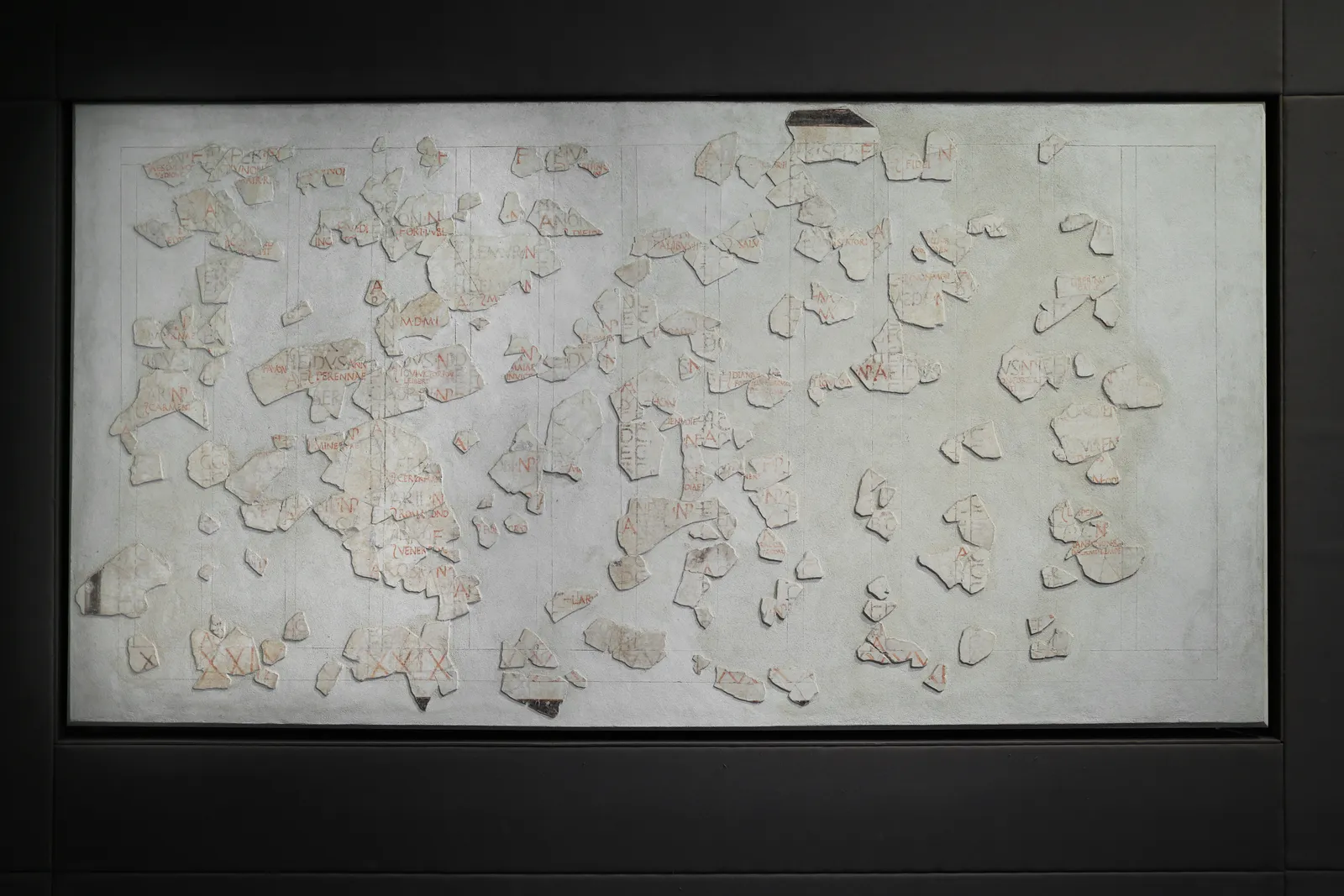
the same entry adds something varro does not say. on those days, «battle was not joined with the enemy, no army was enrolled, no comitia were held, and nothing else was done in the state except what the direst necessity demanded». the assemblies, then, are on the list, though not on varro’s. and here the record clashes with itself: in the surviving calendars, 5 october carries the letter c, comitialis, a day on which the people could lawfully be assembled to vote. that is how the fasti of the arval brethren read, and in the painted calendar of antium, the only one older than caesar’s reform, that day’s entry is restored entirely. the arval calendar notes nothing about the mundus. the two things do not fit, and there is no need to make them fit.
rome refrained from starting a war or marrying anyone off because of a place we cannot now locate in its own city.
the popular image — a pit covered by a stone that was lifted three times a year to let the dead out — is not complete in any ancient source on the mundus. varro’s «door» is a comparison, quasi ianua. the stone comes from another entry in the same dictionary, that of the manalis lapis, which «they believed to be the door of orcus, through which the souls of those below flowed to those above», and which does not mention the mundus. platner and ashby call identifying that stone with the lid of the mundus «pure conjecture».
the oldest witness is cato, in a fragment that festus himself preserves. he says the name comes from the mundus that is above us, the sky, because its shape resembles it, «as i was able to learn from those who have gone in» — and that «i was able» is a modern emendation of the text. so, a place one went down into. its lower part was as it were consecrated to the di manes and stayed closed all year except on those three days. what cato does not mention, as fowler stresses, is either the stone or the coming out of the dead: for those ideas the oldest witness is varro, followed by capito.
what was it for, then? fowler proposed that it was originally an underground store for seed, and that the gateway to the underworld was a later layer, of greek and etruscan influence. he had already suggested it in 1899, following an old suggestion of o. müller based on the first fruits that plutarch has thrown into the pit of the foundation, and in 1912 he argued it from the three dates: 24 august falls on the eve of the opiconsivia, with the harvest already stored; 5 october, in the middle of the sowing of far; 8 november, close to the setting of the pleiades, when the agricultural writers prescribe sowing wheat. it is a hypothesis, not a fact.
and there remains the site. plutarch says that romulus dug a circular pit around what in his day was the comitium, threw into it the first fruits and the earth each settler brought from his own country, and that this pit was called by the same name as the sky. ovid describes the same foundation pit, with the corn and earth from the neighbouring soil, but does not call it mundus. fowler in 1899 wrote that plutarch was wrong to place it in the comitium, and platner and ashby put it down to a confusion; since coarelli, in the seventies, part of scholarship has given him back his credit and looks for the mundus right there. the traditional identification with the roma quadrata of the palatine was taken by platner and ashby to be made «without sufficient foundation», and the vaulted chamber that came to light in 1914 beneath the domus augustana, with a central shaft and two galleries cut into the rock, was proposed as the mundus; platner and ashby record the proposal without endorsing it. platner and ashby’s own dictionary summed it up in 1929: we have absolutely no information about the site of the mundus.