

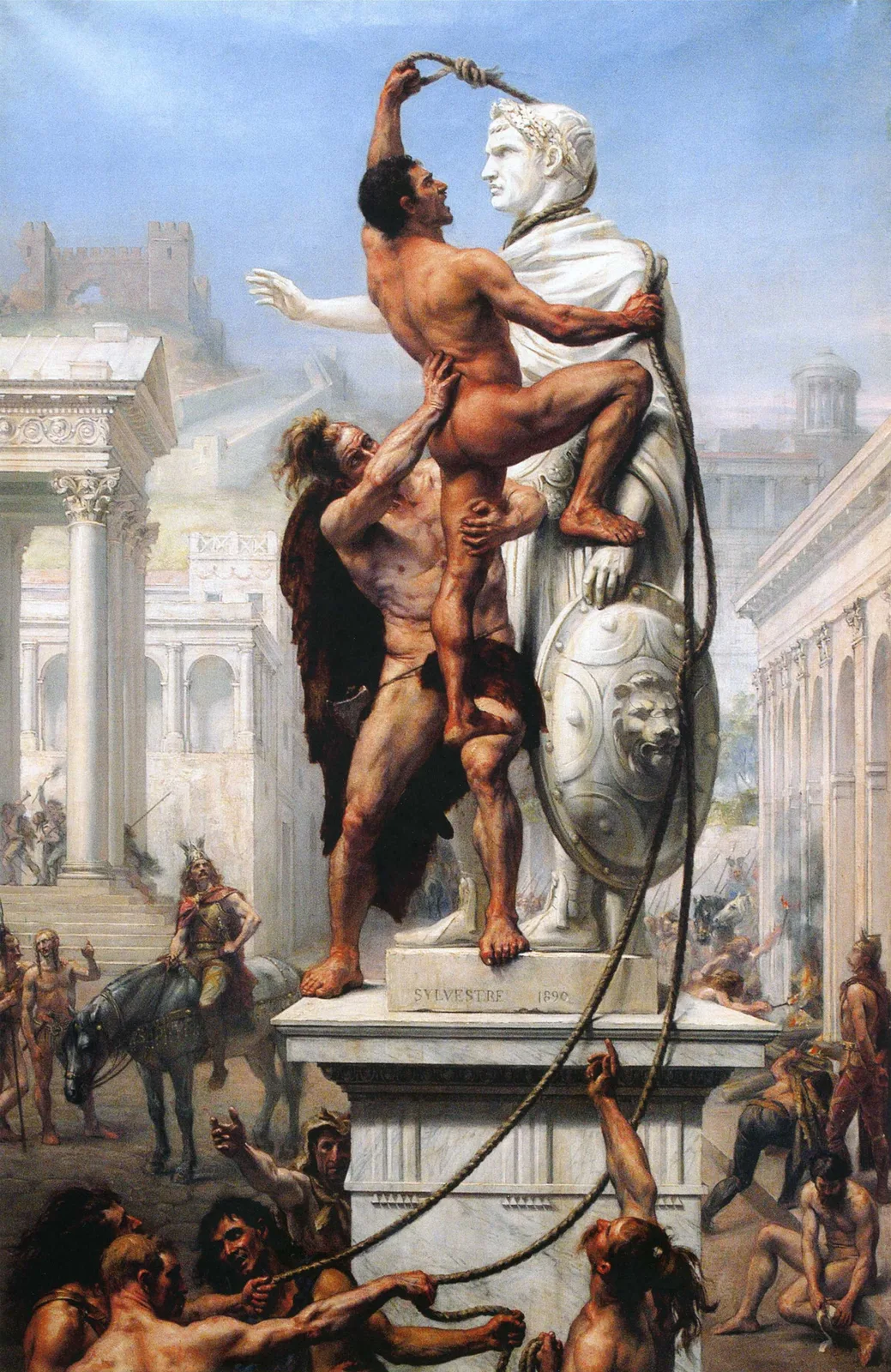
for the first time in eight hundred years, a foreign army broke through the gates of rome. it happened on a day like today, 24 august in the year 410 of our era, and the ancient world understood that nothing lasts forever.
it is worth beginning with the part that almost never gets told: alaric did not arrive like a storm out of nowhere. king of the visigoths and a former officer in imperial service, he had spent years asking the court at ravenna for the same thing over and over — land on which to settle his people and an official command in the roman army. what he got was silence, broken promises and an ambush during a negotiation. he laid siege to rome three times. on the first two he lifted the siege in exchange for a ransom and for the word of a government that had no intention of keeping it.
the third time he got in. procopius reports that someone opened the salarian gate from the inside during the night, and he also passes on the romantic version: a compassionate matron, sickened by the hunger of the siege, who gave the order to draw back the bolt. current scholarship treats that account as an edifying legend and settles for the likelier and more uncomfortable explanation: a betrayal, nothing more.
the sack lasted three days. alaric was an arian christian —a branch of christianity that denied the full divinity of christ— and he ordered the basilicas spared and anyone sheltering in them left unharmed. the rest of the city was plundered at leisure: the senatorial palaces, the treasures piled up over centuries, the imperial warehouses. then the goths marched off to the south. there was no occupation, no gothic government, no general burning of the city.
the city that conquered the whole world has been conquered.
the line is jerome’s, written from his monastery in bethlehem in letter 127, and it explains what happened that august better than any figure can: the blow was symbolic before it was material. from africa, augustine set about writing the city of god to answer those who blamed the disaster on the abandonment of the old gods. the sack of rome did not bring down an empire; it brought down the idea that rome could not fall.
and there is a coincidence of the calendar that would have frozen a roman’s blood. 24 august was one of the three days of the year on which, according to festus and macrobius, the mundus was opened: the ritual pit that joined the city to the world of the dead. they were ill-omened days, on which no battles were fought and no weddings held. on the day rome fell, the door to the underworld was, for them, standing open.
alaric did not enjoy the spoils. he died a few months later in calabria, and jordanes preserves the legend that the course of the river busento was diverted so that he could be buried in its bed with his treasure, the slaves who dug the grave being killed afterwards so that nobody could find it. not since the gauls, in 390 before our era, had anyone violated the city. it is worth not overstating what followed: the western empire held out another sixty-six years and the eastern one a millennium. what that 24 august proved was not that rome was finished, but that the eternal city was, after all, mortal.