

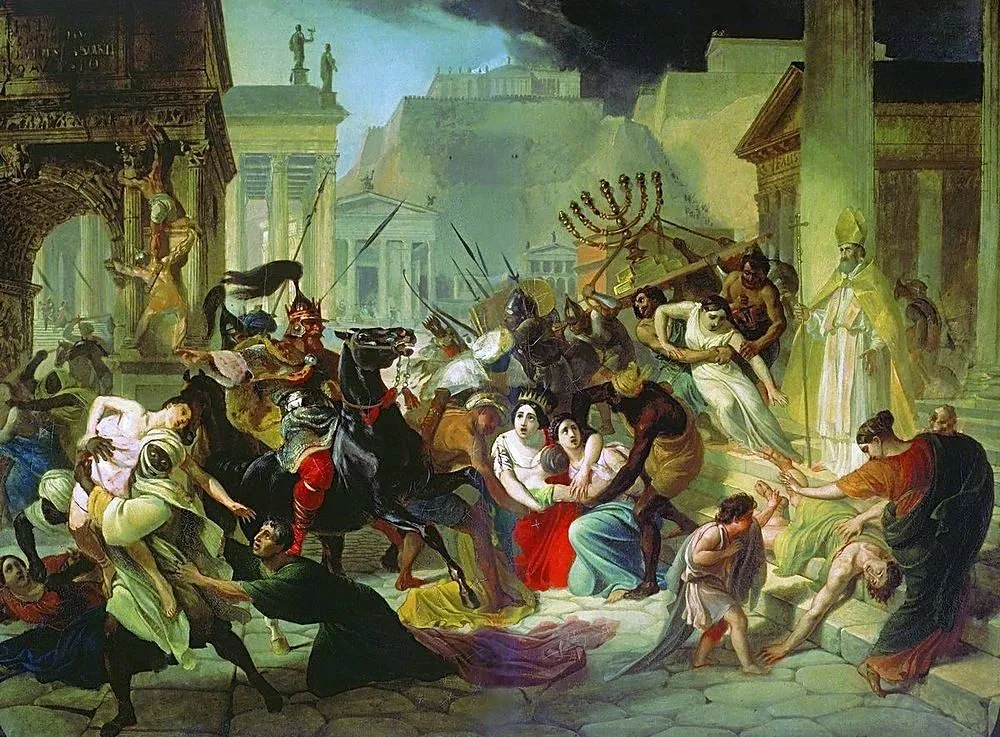
the word vandalism was born of a misunderstanding. when genseric, king of the vandals, entered rome in early june of the year 455, he did not wreck the city out of sheer frenzy: he emptied it with the coolness of a man taking inventory. for two weeks his men took down treasures, melted down protocol and loaded hostages aboard ship while rome, a capital without an army, looked on and could do nothing.
to understand why the city was so defenceless one must go back to 439, when genseric had seized carthage by surprise. with it he gained the granary of the west and the finest fleet in the mediterranean. from north africa the vandals could cut off the grain supply that fed italy and land wherever they pleased. rome, by contrast, had ceased to be a military centre: for half a century real power had been drifting towards ravenna and constantinople, and although valentinian iii had brought the court back to rome around 450, the city still had no field army behind its walls. the aurelian walls still stood, imposing, but behind them scarcely any garrison remained. the city was by now, as the saying goes, a monumental museum inhabited by aristocrats.
the trigger was a dynastic crisis. in march of 455 the emperor valentinian iii had been assassinated, and the senator petronius maximus seized the throne by forcibly marrying the widow, the augusta licinia eudoxia. genseric judged that the pact binding him to the imperial house had lapsed and set sail for the tiber. tradition adds that it was eudoxia herself who secretly summoned him to take revenge on maximus; it is worth qualifying that this version, recorded by procopius, is doubtful and smells of a romantic legend built up afterwards. what is certain is that maximus, seized by panic, tried to flee and was lynched by the crowd days before the fleet dropped anchor.
here appears the most famous scene, and also the most fragile in documentary terms. according to the ecclesiastical tradition recorded by prosper of aquitaine, pope leo i went out to the city gates to parley with genseric and wrung from him the promise not to burn rome, not to massacre its inhabitants and not to subject them to torture. it is the same gesture legend attributes to leo before attila two years earlier. it should be read with caution: prosper is terse, and popular writing tends to inflate both the pope’s eloquence and its real effect. that genseric did not torch the city may have owed less to pontifical oratory than to the plain calculation of a methodical plunderer, for whom fire only ruins the spoils.
they did not need to set the eternal city alight to extinguish it: it was enough to carry it off in pieces, one ship after another, over fourteen days.
for the sack, that much is true, was exhaustive. prosper of aquitaine, a witness to those years, sums up the episode in a chilling sentence: for fourteen days, in a calm and unhindered reckoning, rome was emptied of all its riches. procopius describes the plunder in detail. from the capitol they tore off half the gilded bronze tiles that covered the temple of jupiter optimus maximus. from the imperial palace came the gold, the silver and the furnishings of several centuries. and from the templum pacis — the temple of peace, where vespasian had deposited the spoils of jerusalem after destroying its temple in the year 70 — they carried off, it seems, the seven-branched menorah and the table of the showbread, the sacred relics of judaism that had stood on display in rome for three and a half centuries — procopius recognises them decades later among the vandal spoils, from which it is inferred that they left rome in this sack.
the loot was not confined to metals. genseric shipped to carthage the empress licinia eudoxia and her two daughters, eudocia and placidia, held as pledges for future agreements. and with them, according to procopius, thousands of captives, among whom the king carefully picked out craftsmen and technicians: to a young kingdom in africa, living engineers were worth more than a marble statue. the detail matters: what later legend twisted into sheer barbarity answered to an administrative logic. the vandals were not seeking to govern italy or wipe rome off the map; they were after capital, skilled labour and negotiable hostages.
the epilogue carries a long irony. almost eighty years later, in 533-534, the byzantine general belisarius crushed the vandal kingdom and sacked carthage in his turn. among the treasure recovered, recounts procopius — who was there, in belisarius’s retinue — the relics of the temple of jerusalem reappeared, travelling on to constantinople to parade in justinian’s triumph. the gold wrenched from rome had changed hands once more. what no plunder could give back was what those fourteen days had made plain: that the city which called itself eternal could be emptied like a cupboard, and that the empire of the west, now without grain, without fleet and without defence, would take less than a generation to go out altogether.