

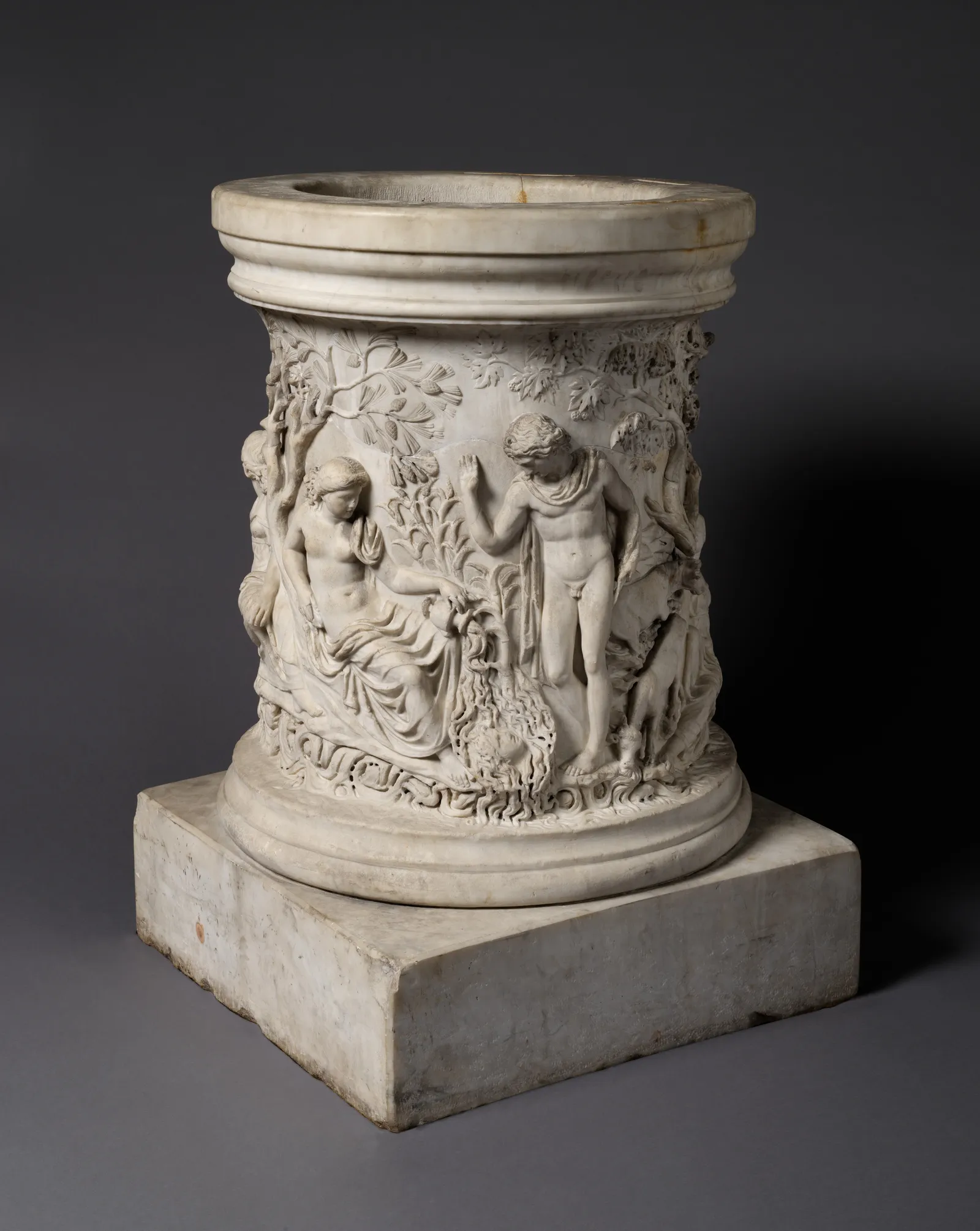
one day a year, in rome, garlands of flowers were thrown into the springs and the wells had a garland set on top of them. this was the fontinalia, and it fell every 13 october. varro tells us so in the sixth book of his treatise on the latin language, and he says it in a single sentence: «from fons, because that day is his festival; that is why they then throw garlands into the springs and crown the wells». varro is explaining where a name comes from, not describing a ceremony. he does not say who officiated, nor what was asked for, nor a word about running or channelled water.
the name itself has two forms, and it is worth showing them. the critical text of varro writes fontanalia, with an a: that is how the editions of goetz and schoell and of kent print it, with no note on the form. fontinalia, with an i, is the form of the lexicographical tradition, the one that has fixed the name in modern scholarship and the one that explains the porta fontinalis; and it is also the one warde fowler prints when he quotes varro, normalising him. anyone who opens one book and then another will see both.
that sentence of varro is the only ancient description of the gesture. but it is not the only trace of the festival. the dictionary of verrius flaccus, of the augustan age, which we know only as summarised by festus and summarised again by paul the deacon in the eighth century, dispatches it in two words — fontinalia, fontium sacra, «rites of the springs» — and adds: «hence also, in rome, the fontinal gate». it does not copy varro: it defines the festival differently and names a gate he does not name. fowler wrote that all that is known of this very ancient festival fits into a few words of varro, but his own note also refers to festus, so the sentence can only be quoted with its note.
the day is also in the calendars. fowler, in 1899, recorded it marked np and with font[inalia] in several stone calendars, all of the augustan age or later, and with feriae fonti, «festival of fons», in that of amiternum. the origin of the mark np is still unresolved, and fowler himself acknowledged as much; it should not be glossed as «public holiday» without saying so. sixteen years after his book there came to light at antium the only roman calendar older than caesar’s reform to survive, painted on stucco, and in its october column the 13th keeps the name, fo[n]t(inalia), with a single letter restored, although the mark np is restored: the festival is attested well within the republic. and four centuries later it was gone: in the calendar of filocalus, of the year 354, 13 october says games of jupiter liberator.
what rome built could be measured in paces, and frontinus measured all of it. what was thrown into a well could not.
was there a god fons? varro makes him the owner of the day, and cicero records a shrine of his, a delubrum fontis dedicated by a maso «of corsica», although the passage is a reductio ad absurdum against the stoics in the mouth of cotta — if the earth is a goddess, so too will be the rivers and the springs —, not a description of cult. the same cicero uses the altar of fons as a topographical reference: the tomb of numa, he says, stood not far from it. placing that altar on the janiculum means joining his sentence to another of livy’s, who says that in 181 bce a chest labelled as the tomb of numa turned up «below the janiculum», and that when opened it was empty: it is an inference, not a fact. the fontinal gate is alive in 193 bce, when two aediles run a portico from it to the altar of mars; fowler placed it on the campus martius, but platner and ashby know it only from two literary passages and three inscriptions, and place it, with doubts, north-east of the capitol. fowler’s doubt is not whether fons existed, but what kind of god he was: a case, he writes, in which multiplicity passes into a near unity, «but fons did not long survive in that phase».
what follows is this entry’s reading, not the sources’: varro does not mention aqueducts and frontinus mentions neither the fontinalia nor fons. frontinus, whom nerva put in charge of rome’s waters, opens his treatise with a count: for four hundred and forty-one years from the foundation the romans made do with the water they drew from the tiber, from wells or from springs. the first aqueduct, the appia, was brought in by the censor appius claudius in 312 bce, and of its eleven thousand one hundred and ninety paces, eleven thousand one hundred and thirty ran underground: rome’s first aqueduct could hardly be seen. when frontinus writes, nine come in — appia, anio vetus, marcia, tepula, iulia, virgo, alsietina, also called augusta, claudia and anio novus —. not eleven: eleven is the later count.
what is remarkable is where he puts a sentence he did not need. between the wells of before and the list of the nine, frontinus writes that the memory of the springs is kept with veneration, that they still receive cult and that they are believed to heal the sick, like those of the camenae, of apollo and of juturna. it is the water official who writes it: what was channelled had not displaced what springs up of its own accord. fowler conjectured that the garlands served to ensure abundant water; it is a conjecture, and he presents it as such. the fontinalia, moreover, were not an agrarian rite but one of springs and wells, and they sat in the calendar right next to the wine-tasting of the meditrinalia on the 11th and the festival of augustus on the 12th.