

the roman army recycled its legionary numerals for centuries: a unit wiped out would be raised again under the same figure. three of them, as far as the surviving inscriptions reach, stop appearing after the year 9 of our era: the seventeenth, the eighteenth and the nineteenth. they were lost with the governor publius quinctilius varus somewhere in germania east of the rhine, and it is worth starting with what the sources do not say: none of them gives the day. the 9th of september is a modern convention. suetonius tells us that augustus kept the anniversary of the disaster every year as a day of mourning — in rome they knew perfectly well which day it was — but he never wrote down which one.
the man who destroyed them was no outside enemy. arminius, son of sigimer, was a prince of the cherusci and at the same time a roman citizen and a member of the equestrian order, the rung of the roman elite just below the senate. velleius paterculus, writing around the year 30 and the closest witness in time, calls him at ii, 118 adsiduus militiae nostrae prioris comes, a constant companion of our earlier campaign. that is all the source says: that he commanded auxiliary troops or trained as an officer are modern inferences, much repeated but inferences.
the governor has been cast as the dupe, and that casting has an author. velleius writes under tiberius and needs a culprit with a name so that the disaster is charged neither to the high command nor to the policy of augustus: hence a varus slow of body and of mind, more at home in camp than in war, who entered a rich province poor and left it rich from a province made poor. one thing deserves the nuance that popular history tends to run over: that portrait is a defence brief, not a report, and much recent scholarship works precisely on the rehabilitation of varus. velleius himself, at ii, 118, 4, admits that segestes warned him and asked him to put the conspirators in chains. he had the information and did not use it, which is a different reproach from being a fool.
of the defeat whose anniversary augustus kept in mourning we do not know for certain even the day.
nor was the conspiracy a personal notion of arminius. cassius dio, writing two centuries later, presents it at lvi, 19 as a collective manoeuvre: the conspirators stirred up a revolt among distant peoples so that varus would march out to put it down, escorted him part of the way and then stayed behind on the pretext of gathering allies. the course of the battle, however, does not depend on dio. velleius sums up the annihilation in three words — silvis, paludibus, insidiis, forests, marshes and ambushes — and tacitus, at annals i, 61, describes two successive camps: the first, by its perimeter, the work of three legions; the second with its rampart half fallen and its ditch shallow, the entrenchment of what was left. that is an action of several days, not a clash. what belongs to dio alone is the rain. varus ran himself through with his own sword.
suetonius tells us that augustus went months without cutting his hair or his beard, and that he would beat his head against a door shouting «quinctilius varus, give me back my legions». six years later germanicus reached the site and found what tacitus turned into one of his finest pages: whitened bones lying where the men had fled or had stood their ground, and heads nailed to the trunks of trees — heads, says the latin, not skulls. they buried what they could. of the three eagles, germanicus recovered two: that of the nineteenth among the bructeri, and another pointed out to him by a chief of the marsi. the third took thirty years more; publius gabinius got it back in the year 41, under claudius by then, and dio describes it as the only one still remaining in enemy hands. rome crossed the rhine again more than once; the province being assembled towards the elbe was never rebuilt.
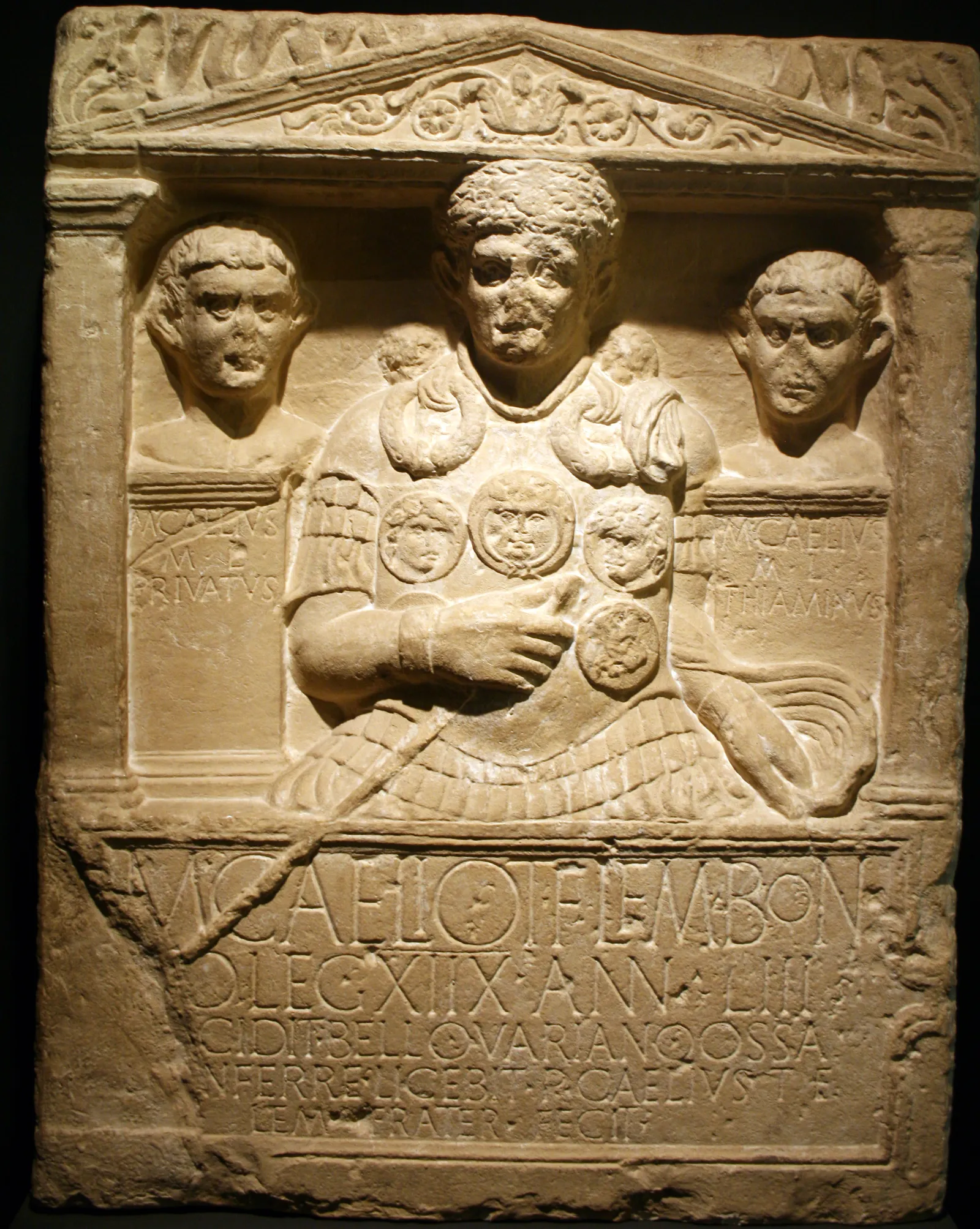
that leaves the numbers, and the silence there is stranger than it looks. the eighteenth is attested in stone: the stele of the centurion marcus caelius, in bonn, reads leg. XIIX and says that he fell bello variano, in the war of varus; it is not a grave but a cenotaph, because the brother who raised it left it written that the bones might still be laid there if they turned up. the nineteenth is named by tacitus. the seventeenth is named by nobody: apart from one highly ambiguous inscription that has to be read backwards, it appears in no text, and its existence is a modern hypothesis deduced from the gap it leaves in the numbering of the augustan army. no ancient source records any decision to retire the three numerals; what we know is that they do not turn up again. the seventeenth exists, above all, in that gap.