

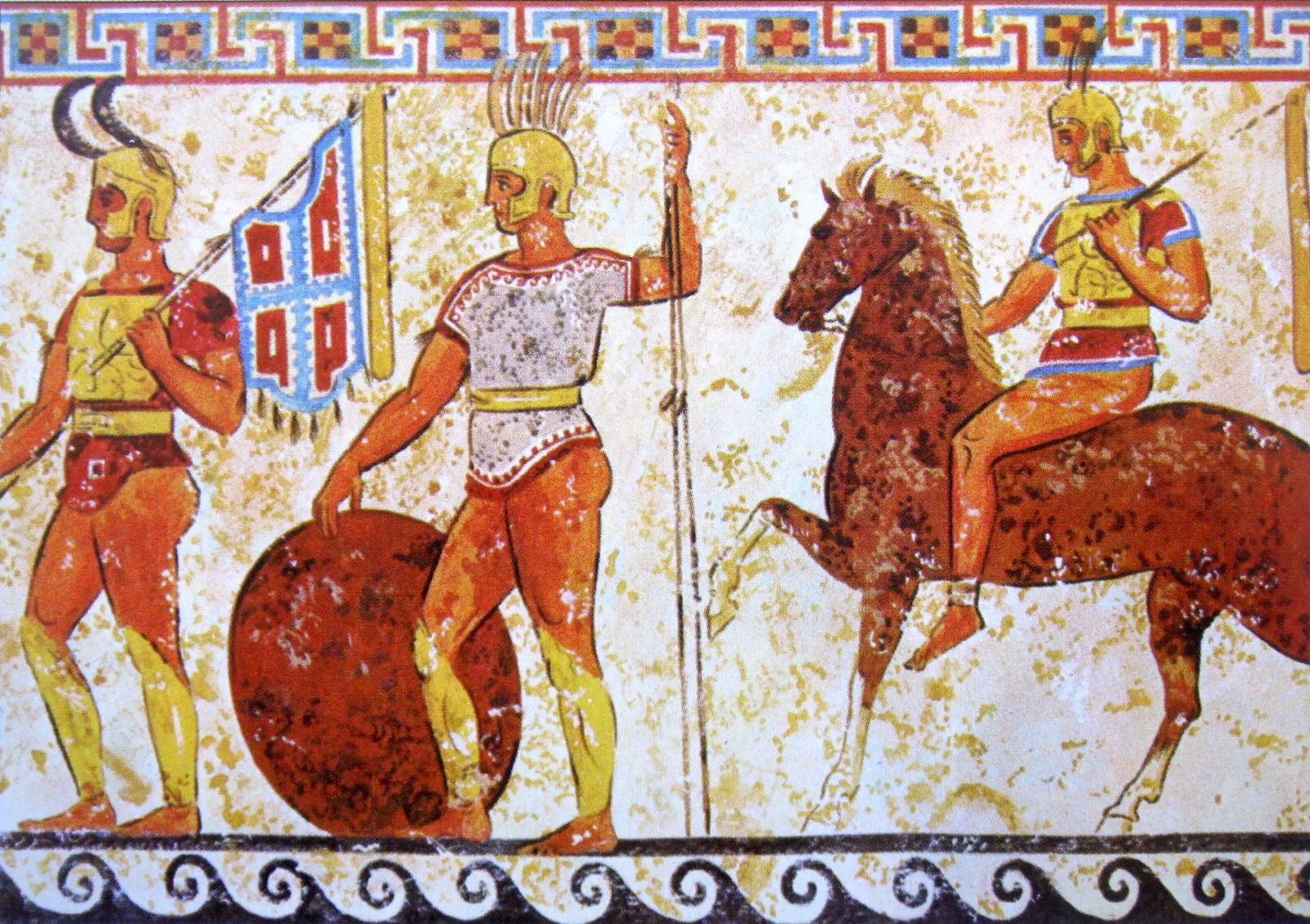
for generations, rome fought the same way the whole mediterranean basin did: in a phalanx. a compact wall of men shoulder to shoulder, round shield and spear thrust forward, advancing as a single mass and crushing whatever stood before it. it was a formation inherited from the greek world, simple and fearsome on level ground. and it was also, though no one yet knew it, a trap the moment the terrain ceased to be flat.
the trouble came when rome turned its gaze towards southern italy and collided with the samnites, a people of mountaineers hardened in the apennines. they did not offer battle in the open field, where the phalanx reigned, but fought in narrow valleys, broken slopes and gorges. there the spear-wall was all but useless: it took only a rock or a rise to open a gap in the line for the enemy to slip through the breach and turn the formation into a slaughter. a phalanx needs smooth ground and protected flanks; the samnites denied it both.
the roman answer was one of the most fertile military reorganisations of antiquity: to break that single block into small, semi-autonomous units, the maniples — from the latin manipulus, literally “a handful”. in its developed form, as polybius would later describe it in book vi of his histories, each maniple of the first two troop types numbered around one hundred and twenty men, and the ten units of each line deployed with gaps between them, so that the second line covered the spaces of the first. seen from above, the whole resembled the alternating squares of a board: an arrangement later tradition called the quincunx.
rome stopped fighting like a single wall that breaks at the first crack and learned to fight like many blocks that rearrange themselves.
the advantage was twofold. tactically, if a maniple ran into an obstacle or a stiff resistance, it could manoeuvre on its own without dragging the rest of the legion along: the army ceased to be a clumsy steamroller and became an articulated machine that adapted to the ground. materially, as livy recounts in book viii, the romans swapped the old greek-style round shield for the scutum, the great oblong shield that better protected the isolated fighter. and psychologically, the system allowed something the phalanx smothered: to channel individual daring within an iron discipline, giving each man a place to fight without breaking the order of the whole.
now the historiographical nuance, which it is best not to skip, because popular accounts tend to trample it. the idea of a clean “manipular reform”, with a date and an author, is a convenience of the ancient narratives, not a proven fact. both livy and polybius describe the army already transformed and project it backwards as though it had sprung from a deliberate act; livy even threads his famous description of the manipular legion into the story of the latin war, around 340 bce, with his usual taste for the orderly tableau. modern criticism — goldsworthy among others — leans towards something far less heroic: a gradual adaptation, over several decades, across the samnite wars of the fourth century, with no single reformer and probably under the influence of the samnites’ own tactics. the round date of “the mid-fourth century” is a convenient label for a diffuse process, not the mark of any one day.
it is also worth dispelling a common confusion: that of the weaponry. the oblong shield fits this horizon, but the short sword we tend to picture in the legionary’s hand — the gladius hispaniensis, of iberian inspiration — does not arrive until more than a century later, in the thick of the war against hannibal. to credit the fourth-century maniple with the full kit of the classical legionary is to project backwards an image that had yet to take shape. what can be affirmed is the direction of the change: from the rigidity of the phalanx to the flexibility of the independent block.
the reach of that reorganisation would be measured in centuries. the manipular legion was the instrument with which rome first subdued its italic neighbours and then measured itself, under very different conditions, against the very weapon it had abandoned: the hellenistic pike phalanx. when the two systems met again in southern italy and in the east, the compact wall would discover in its own flesh what the samnites had taught rome in the mountains. but that new iron discipline had a darker side too, and it would soon claim a victim no one expected: the very blood of the general in command.