

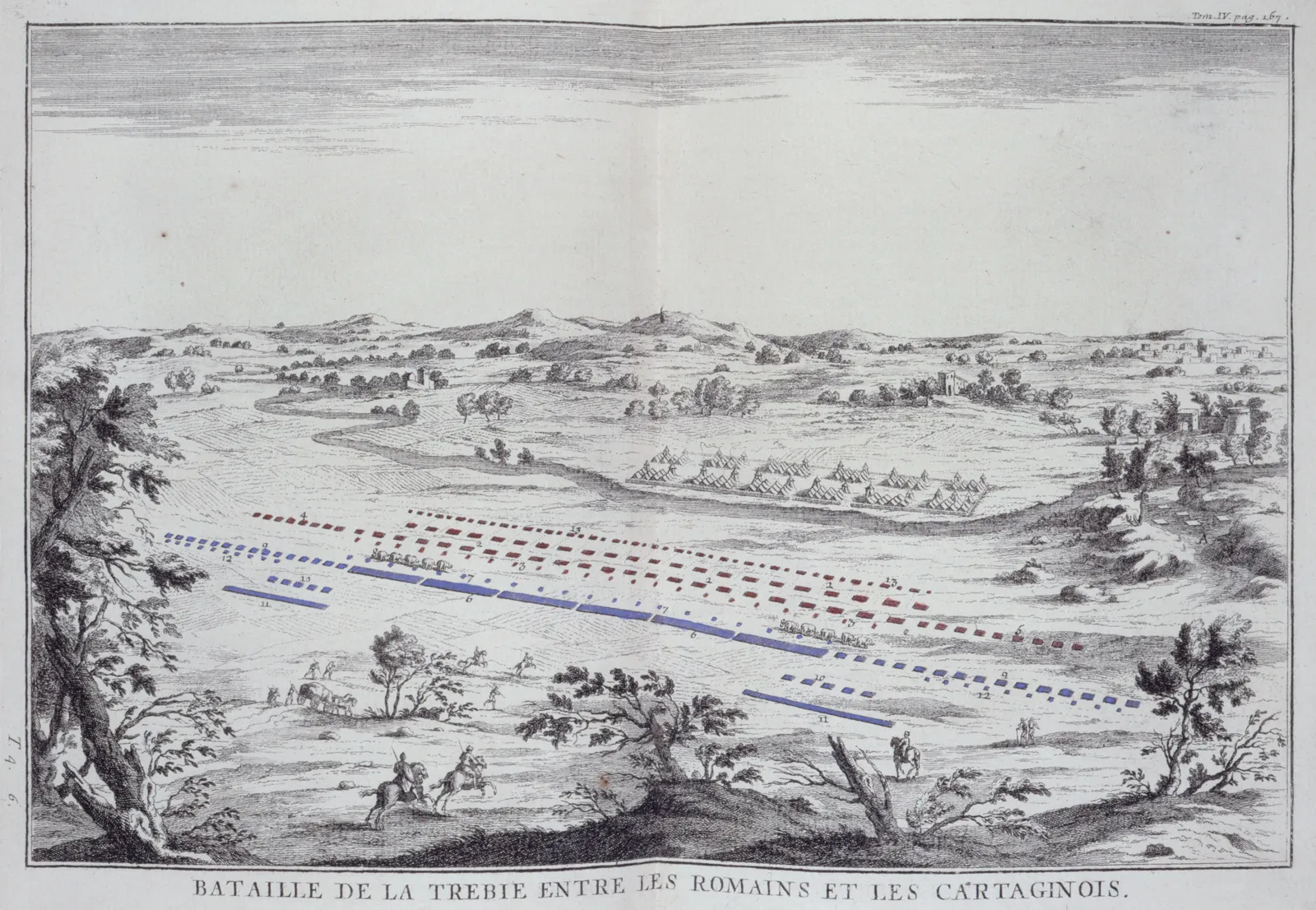
within a matter of weeks, at the end of 218 before our era, hannibal defeated rome twice in the po plain. the first was a cavalry clash by the river ticinus; the second, by the trebia, a trap into which both consular armies of the year fell, by then united. almost everything we know of the two is told by polybius and livy, and on the two most remembered points — who saved the consul and how many escaped — they do not tell the same thing.
just down from the alps, hannibal took the chief city of the taurini in three days. the other gauls of the plain, polybius reports, were eager to join the carthaginians, as they had planned from the start, but the roman legions had advanced beyond most of them and blocked their way, so they held still; some were even serving with rome under compulsion. livy says the same: the consul publius cornelius scipio arrived in time to catch them while they were still waiting for the moment to rebel. the adherence of the gauls was not the cause of hannibal’s victories but their consequence.
scipio crossed the po and bridged the ticinus. days later, the two generals rode out with their cavalry to reconnoitre the enemy and met on the plain, warned by the clouds of dust. hannibal put his heavy cavalry in front and the numidians on the wings; the roman javelin men fled before throwing their first volley. polybius stresses that the fight was evenly balanced for a good while, until the numidians outflanked the romans and attacked them from behind; livy calls it aliquamdiu anceps, doubtful for a time. the roman cavalry scattered, and only a few rallied around the consul, gravely wounded.
who got him out of there is the first discrepancy. polybius knows it from gaius laelius, a friend of africanus since youth: the consul’s son, seventeen years old and on his first campaign, saw his father surrounded, with two or three horsemen as escort, and as his own men hesitated, he charged the enemy alone until the others followed him. livy knows another version, that of coelius antipater, who credits the rescue to a ligurian slave; he prefers the son’s because more authors give it and because fama obtinuit, it prevailed. it is the version the video tells, and it is worth knowing that it came from an intimate of the man who was saved.
after the victory, the neighbouring celts rushed to ally themselves with hannibal. some two thousand gallic foot serving in the roman camp attacked their comrades before dawn and went over to the enemy with the heads of the dead. scipio withdrew towards the trebia and the nearby hills to wait for his colleague.
the romans were afraid of the woods; hannibal waited for them on a treeless plain.
the second consular army was coming from sicily. tiberius sempronius longus was at lilybaeum preparing the invasion of africa when the senate ordered him back, and his men, polybius reports, marched forty days from lilybaeum to ariminum before joining scipio. a skirmish won filled him with confidence. scipio, wounded, advised waiting and training the legions through the winter; sempronius wanted battle, and polybius gives the reason: ambition drove him, he wanted to strike the decisive blow himself before scipio recovered or the consuls-elect took office, because the date was already approaching. livy gives the same one: ne in novos consules bellum differretur. the moral framing is the sources’, but the two agree.
hannibal had seen between the two camps a flat, treeless place crossed by a stream with steep banks, covered in brambles and scrub; livy adds the marsh grass. polybius explains the choice: the romans distrusted woods, where the gauls liked to lay ambushes, but not open plains. hannibal gave the ambush to his brother mago, who was very young. he picked a hundred horsemen and a hundred foot, ordered each of them to choose ten of the bravest in his unit, and during the night the force, now a thousand horse and a thousand foot, occupied the stream.
at dawn, the numidians crossed the river and provoked the roman camp. sempronius sent out first the cavalry, then six thousand javelin men and finally the whole army. it was around the winter solstice, polybius says, a freezing, snowy day, and almost all went out without having eaten. the trebia was swollen by the night’s rain and the infantry forded it with the water up to their chests; livy writes pectoribus tenus. meanwhile, the carthaginians had eaten breakfast and were rubbing themselves with oil by their fires.
polybius counts sixteen thousand romans and twenty thousand allies on foot, plus some four thousand horse; livy says eighteen thousand romans, twenty thousand latin allies and a contingent of cenomani, the only gauls who stayed loyal. the carthaginian cavalry, more numerous and fresh, swept the wings, and the elephants and the light infantry harried the flanks. then the men in ambush came out and fell on the rear of the centre. the roman front line broke through the line of gauls and africans before it and, seeing the wings lost and the way back to the camp cut off by the river and the rain, withdrew in formation to placentia: no fewer than ten thousand men, according to polybius. of the rest, he adds, most died by the river, although a few foot soldiers and most of the cavalry managed to join that column.
here the video simplifies. «only ten thousand» is the figure for the column that cut its way through, not for all the survivors. livy gives more: some crossed the river and returned to the camp, and the following night scipio led what was left of the army to placentia, and from there to cremona. the carthaginian losses, according to polybius, fell mostly on the celts; those of the cold that followed, on the elephants.
sempronius wrote to rome that there had been a battle and that the storm had robbed him of victory. livy tells of the city’s terror: one consul beaten at the ticinus, another recalled from sicily, two consuls and two consular armies defeated. hannibal spent the winter in cisalpine gaul among new allies whose loyalty he distrusted; polybius notes that the gauls said they hated rome, but what they sought above all was plunder. the following spring would take him into etruria.