

a roman consular army was destroyed in a single morning, on the shore of lake trasimene, without ever managing to form a battle line. it was in 217 before our era, and it is one of the greatest ambushes recorded in ancient military history. it is told by polybius and by livy, who declares that he followed fabius pictor, a contemporary of that war; on the essentials they agree, and where they do not, it is worth saying so.
having wintered in cisalpine gaul, hannibal looked for a way into etruria before rome expected him. the long roads were also the best watched, so he chose the shortest: the marshes the arno had flooded. polybius reports three days and three nights walking through water, unable to sleep, with the pack animals dying in the mud; livy says four days and three nights. hannibal crossed it on the back of the only elephant he had left and, according to livy, between the damp, the sleepless nights and the lack of place and time to treat himself, he lost the sight of one eye there.
on the other side gaius flaminius was waiting for him, newly entered on his second consulship and encamped before arretium. he is the same man who in 232 had driven through the distribution of the land taken from the senones gauls, and polybius never forgave him for it: he blamed him for corrupting the people and for provoking the gallic war. his portrait of the consul is that of a demagogue with no military talent and great self-confidence, eager to win the victory alone before his colleague arrived. livy paints him in the same colours and adds religion: his opponents reproached him for having entered office outside rome, without the rites of the capitol, and as he set out for trasimene his horse threw him and a standard refused to come out of the ground. these are omens told by a hostile tradition, which turns the defeat into a punishment.
hannibal played on that character. he marched straight past the roman camp and set about laying waste the countryside of etruria, so that the smoke would reach the consul. flaminius, furious, ignored the officers who urged him to wait for the other consul’s reinforcements, and went after him. polybius adds a bitter detail: he was followed by more people in search of plunder than soldiers, carrying chains for the prisoners they meant to take.
the centurions and tribunes, polybius says, did not even understand what was happening.
the road skirted the lake, with the hills of cortona on the left, and narrowed between the slope and the water before opening onto a plain ringed by heights. hannibal deployed his whole army by night: the africans and the iberians on the hill at the far end, closing the exit; the slingers and the light infantry behind the heights on one side; the cavalry and the gauls on those on the other, right up to the very entrance of the pass. flaminius had camped by the lake the evening before, very late, and at dawn he entered the defile without scouting it.
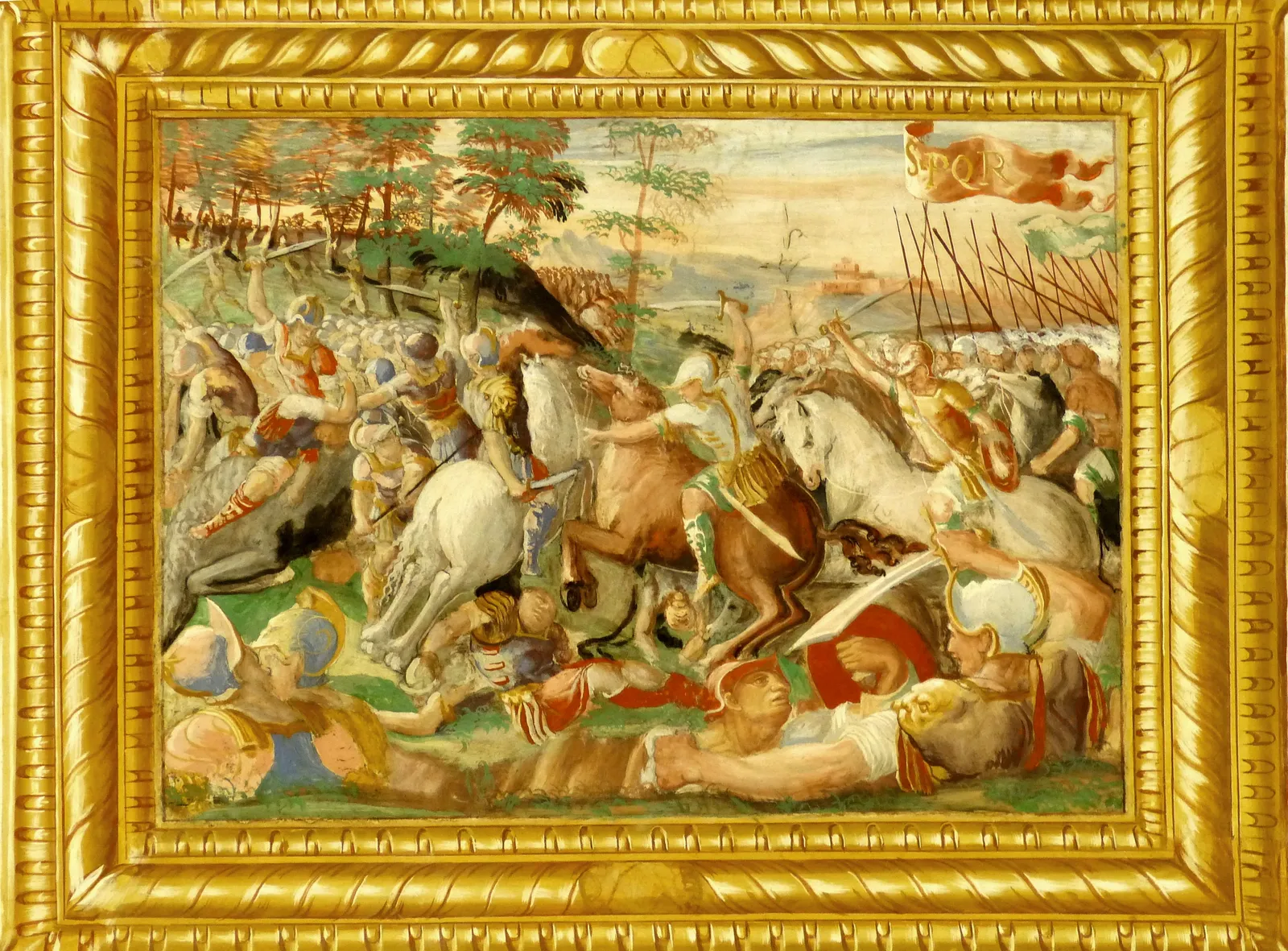
the morning was foggy. when the bulk of the column had entered and its head was already touching the enemy, hannibal gave the signal and all attacked at once from the heights. polybius insists that the fog made it impossible to see and that the roman officers could not even organise their men: they were attacked from the front, from behind and on the flanks, and most died in marching order. livy adds that the fighting lasted three hours, so fierce that no one noticed the earthquake that day which brought down cities in italy.
flaminius died there. polybius only says that some celts killed him; livy gives the horseman a name, the insubrian ducarius, who recognised him and ran him through with his lance. those who were trapped between the slope and the water fared worse. some, polybius says, tried to swim in their armour and drowned; most waded into the lake as far as they could, with their heads above the water, and there the cavalry finished them off. hannibal afterwards searched for the consul’s body to give it burial and, according to livy, did not find it.
the figures have an owner. polybius counts some fifteen thousand romans dead in the valley and more than fifteen thousand prisoners, and some fifteen hundred fallen on the carthaginian side, gauls for the most part. livy gives the same fifteen thousand dead, ten thousand scattered who made their way back to rome by out-of-the-way roads and two thousand five hundred enemy dead in the battle, and he declares his source: he has followed above all fabius pictor, a contemporary of the war, because other authors multiplied the slaughter.
the six thousand of the vanguard are another case of two versions. they broke through the line in front of them and climbed to a height without knowing what was happening behind; when the fog lifted, they saw the disaster and took refuge in an etruscan village. polybius says they surrendered to maharbal after the battle, in exchange for their lives, and that hannibal then declared maharbal had no authority to promise it; livy, that they surrendered the next day, pressed by hunger, and that hannibal loaded them with chains. in both, the roman prisoners were kept captive and the italian allies went home free: hannibal said he had come to liberate italy.
the date, too, comes from the tradition. ovid gives it in the fasti, with a periphrasis: the tenth day counting from the end of the month, which yields 21 june. it is a day of the roman calendar before caesar’s reform, and ovid cites it as a warning: flaminius and the shores of trasimene as witnesses that the gods give warning through birds.
in rome, the praetor announced from the rostra that they had been beaten in a great battle. polybius makes a distinction: the people were dismayed, but the senate kept calm, until three days later news came of another blow, the four thousand horsemen of gaius centenius, killed or captured by maharbal, and then the senate too took fright. livy sums it up thus: the city resorted to a remedy that had long been neither wanted nor used, remedium iam diu neque desideratum nec adhibitum. a dictator.