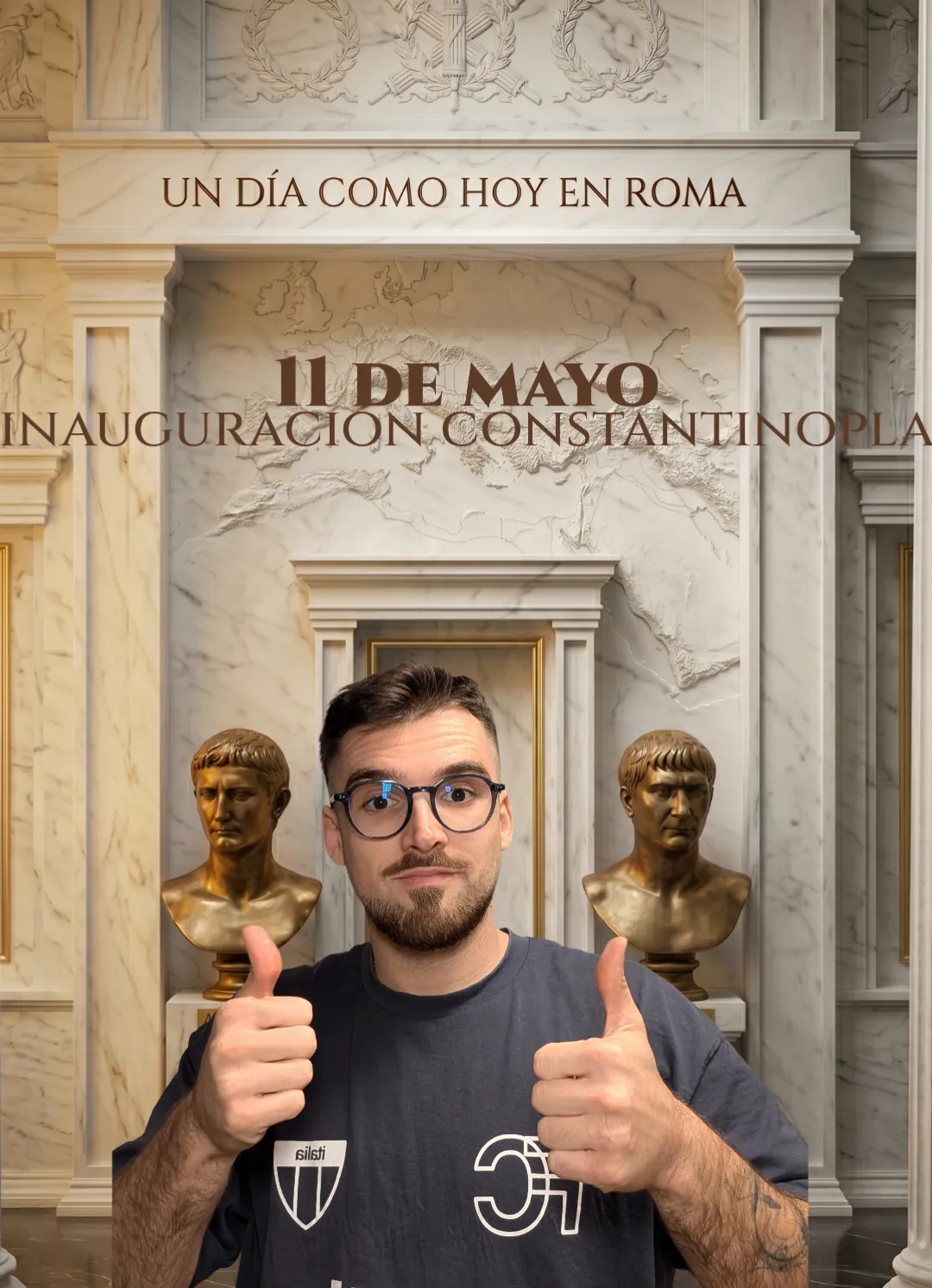


what to do if you are the owner of the most powerful empire in the world and the city that gives it its name has become militarily obsolete. constantine’s answer was radical: build another one. on 11 may 330 ce —the traditional date of the dedicatio according to the constantinopolitan chronicles— he inaugurated his new metropolis on the strait of the bosphorus, and with that gesture publicly admitted what the generals already knew in private: rome had ceased to be the centre of the world.
the version we have inherited paints the city of rome as the eternal engine of the west. but for a fourth-century strategist it was, above all, a problem. it lay far from every hot frontier, too far into the interior of italy, while the real threats were concentrated elsewhere: the sasanian persians pressing in the east; the germanic peoples, along the danube. an emperor needed to be where wars were decided, and rome was no longer that place. it had not, in fact, been the habitual imperial residence for decades: the court moved with the army, and other cities like trier, milan or nicomedia itself had already functioned as de facto capitals. constantine did not break an intact tradition; he completed a move that had been underway for half a century.
the bosphorus, on the other hand, had everything. it was the control point between europe and asia, the hinge of trade and military routes, an extraordinary defensive position almost surrounded by water. and, decisive for feeding a capital, it controlled the flow of egyptian grain and of the eastern coasts, the supply on which every great ancient city depended. constantine chose the site of the old greek colony of byzantium and rebuilt it on an imperial scale, multiplied in walls, fora, palaces and hippodrome.
he formalised in marble what the legions already knew: power had moved to the east.
to grant instant authority to a city without a past, he did what rome did best: plunder. he ordered columns, statues and millennia-old marbles brought from temples and cities across the classical world to dress his new fortress in centuries of borrowed prestige. at the heart of his forum he planted a porphyry column crowned with a statue of himself, and to feed the city he diverted to it the free grain distribution that for centuries had sustained the rome plebs. constantinople was born adorned with the spoils of the paganism its founder was displacing, a christian capital raised with the stones of the old gods, and literally eating the bread of the old capital.
a nuance popular accounts tend to trample is worth setting straight. 330 was not a “division of the empire”: the state was still a single one, and constantine ruled over all of it. constantinople also did not become his exclusive capital overnight; for a time it was one of the great imperial residences, the founder’s favourite, which kept gaining weight until it became indispensable. the formal administrative partition between east and west would come later, with theodosius in 395. what constantine did in 330 was tip the balance for good.
and his calculation paid off on a scale he never imagined. the western half of the empire would collapse in less than a century and a half, but the eastern, anchored in that bosphorus fortress, would survive more than a thousand years, until 1453, keeping alive the administrative, juridical and cultural machinery of rome while western europe fragmented into kingdoms. seen in hindsight, the move contributed decisively to the state’s survival in the east, while the very city that had given him his name and his empire was relegated to a decline that would only be consummated over the centuries.