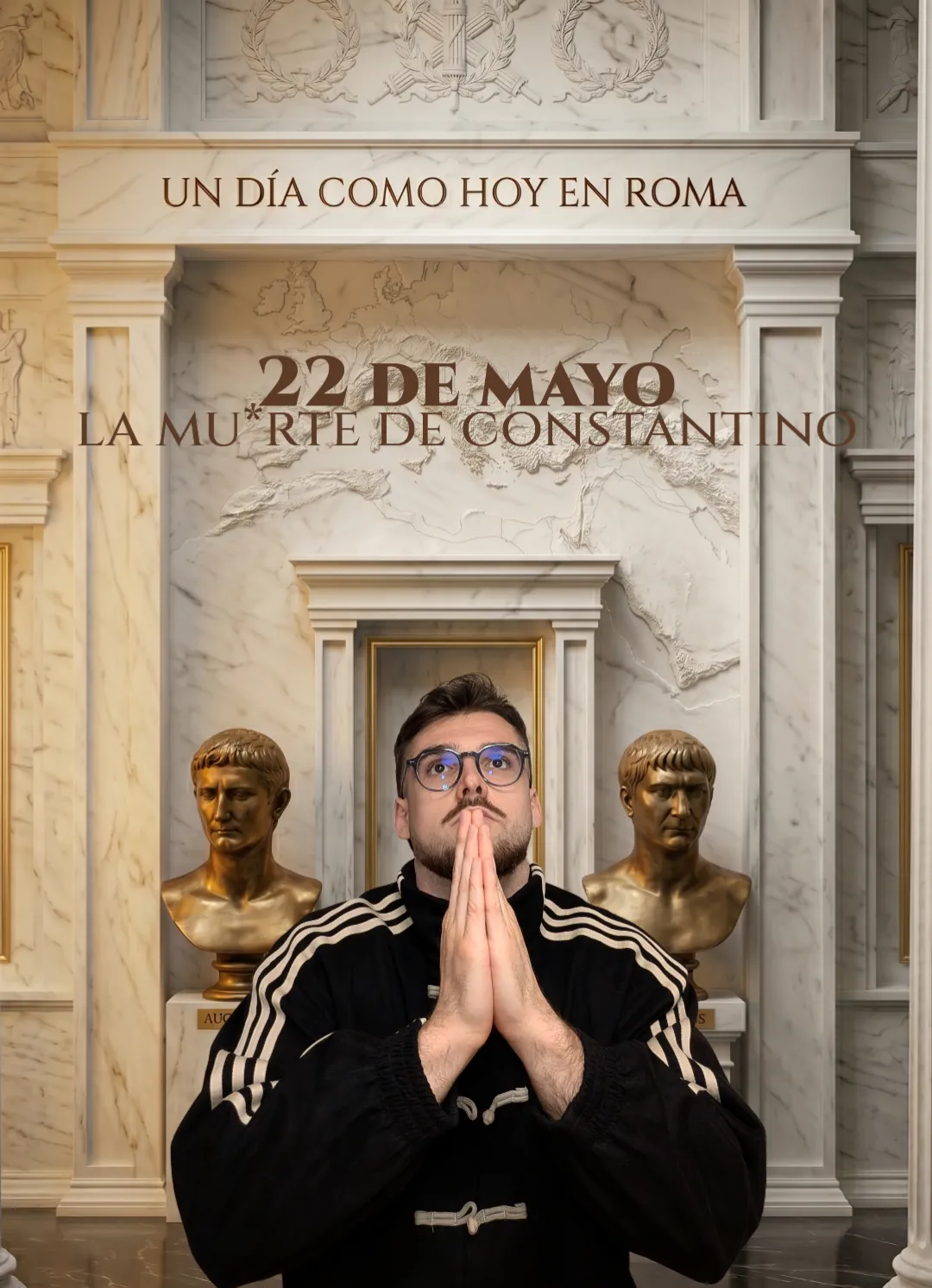


the man who converted the roman empire to christianity had himself baptised when he could no longer get out of bed. it was no oversight or late humility: it was calculation. constantine the great had spent his whole life postponing the sacrament, and chose to receive it with his last breath, in a villa on the outskirts of nicomedia, on 22 may of 337 ce.
to understand the move you have to understand the theology of the moment. in the fourth century, a great many christians believed that baptism wiped away in a single stroke every sin committed up to that instant, but that later faults already weighed on the soul without that great pardon. the consequence was perverse: the later you were baptised, the less room you had to sin again before dying. for many powerful men, postponing it until their final agony was the most efficient spiritual strategy. constantine took it to the extreme.
and he had a great deal to wash off. in the year 326 he had ordered the killing of crispus, his eldest son and a brilliant general, without the sources ever quite explaining the reason: perhaps a court accusation, perhaps a conspiracy, perhaps a domestic scandal. a few weeks later fausta, his wife, also died in murky circumstances that tradition describes as a death by asphyxiation in a bath overheated to the point of suffocation. the emperor who sponsored the new faith had killed his firstborn and his wife within months.
he had eliminated every earthly threat. on his deathbed, he went for celestial absolution.
because constantine was never a naive convert. he built his power by reading the board with the coldness of a strategist. he bet on christianity when it was still a persecuted but iron-tight organised minority; he legalised it, showered it with privileges, presided in person over the council of nicaea in 325 to impose a single dogma on it, and raised a new capital tailored to him on the bosphorus. every move consolidated his monopoly of power. the final baptism fits the same logic: one last calculation, executed at the moment of maximum return.
even so, the cynical version should not be bought whole. deathbed baptism was standard practice at the time, not a stratagem unique to him: many sincere christians did exactly the same thing for exactly the same theology. and the sources each pull in their own direction. eusebius of caesarea, his biographer, signs a hagiography that paints him as a saint guided by providence; the pagan zosimus argues the opposite, that constantine embraced christianity precisely because no traditional religion offered him forgiveness for killing his own. both versions are interested. historical truth lives in the discomfort of the middle ground: a devout and calculating man at once, without either side cancelling out the other.
he was baptised by eusebius of nicomedia, bishop of the arian faction that constantine’s own council had condemned at nicaea, and the emperor died dressed in white, stripped of the purple. he had ordered the killing of his own, shifted the centre of the empire eastward and changed the religion of europe for the thousand years that followed. and he left this world, according to plan, without a single stain on his record.