

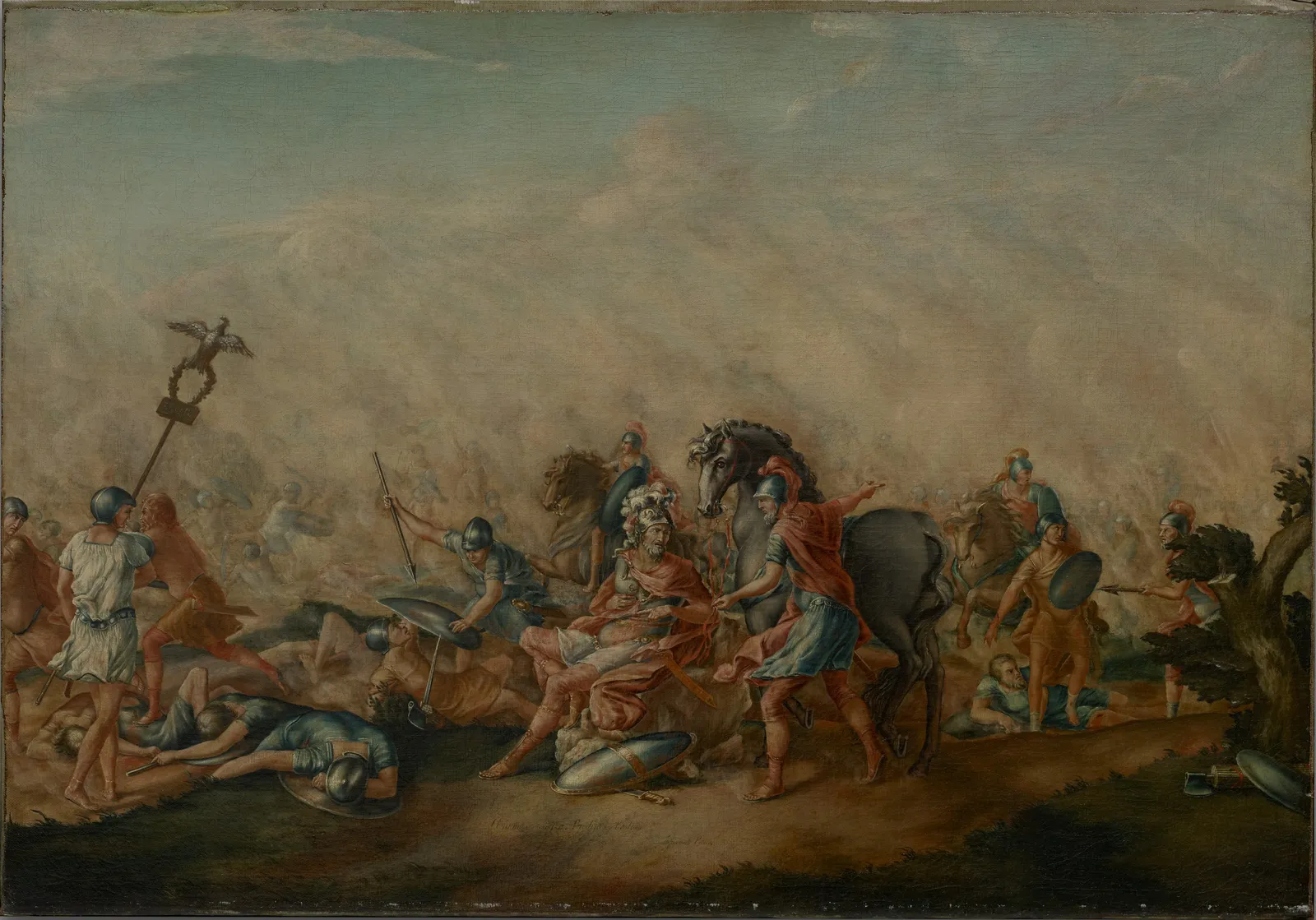
on 2 august 216 before our era, on a plain in apulia by the river aufidus, the largest army rome had ever put into the field advanced against hannibal’s centre believing it was overrunning it. the further it advanced, the deeper it went into a pocket that the carthaginian closed on the flanks and from behind. the two main sources, polybius and livy, agree on the manoeuvre and disagree on almost everything that can be counted.
with fabius maximus’ command over, the senate decided to offer battle. polybius reports that it did so with eight legions, something rome had never done, each brought up to five thousand foot and three hundred horse, plus as many allied infantry; in all there were some eighty thousand foot and a little over six thousand horse. livy is more cautious: the authors disagreed so much on the number and kind of troops that he hardly dares assert anything, though he records that some gave eighty-seven thousand two hundred men in the roman camp. facing them, according to both, hannibal had some forty thousand foot and ten thousand horse. before the battle he had seized the citadel of cannae, where the romans kept the grain of the district.
command was shared by two consuls who took turns day by day. the tradition that polybius and livy follow lays the blame on one of them: lucius aemilius paullus did not want to fight on a treeless plain against a superior cavalry, and gaius terentius varro, out of inexperience, says polybius, held the opposite view. it was varro’s day when the army crossed the river and drew up facing south.
polybius describes hannibal’s deployment precisely. on the left, by the river, the iberian and gallic cavalry of hasdrubal, one of his officers; on the right, the numidians; in the centre, iberians and gauls alternating, with half of the african infantry on each side. then he advanced the central companies of iberians and gauls until they formed a crescent with its convex face towards the enemy, growing thinner towards the ends, and left the africans behind on the flanks: his purpose, polybius writes, was to use them as a reserve and to open the battle with the iberians and the gauls. that they were hidden, as one sometimes reads, neither polybius nor livy says. livy adds a wind that the people of the region called volturnus, which blew dust into the romans’ faces.
hasdrubal’s cavalry clashed first with the roman horse by the river, in a fight without manoeuvre in which the riders ended up dismounting and fighting hand to hand, and destroyed it. in the centre, iberians and gauls held for a while and then gave way, says polybius, overrun by the weight of the legions; the crescent gradually turned inside out and the romans, pursuing them, pressed in towards the centre until they had the africans on both sides. then these wheeled in on the flanks, «as hannibal had foreseen». at the other end, the numidians kept the allied cavalry busy; hasdrubal rode over there, the allied horse fled without waiting for him, and he left the pursuit to the numidians and charged again and again into the rear of the legions. livy also tells of a stratagem that polybius ignores: five hundred numidians who pretended to desert, handed over their weapons and, once behind the roman lines, drew hidden swords and attacked from behind.
livy does not dare give the size of the roman army; polybius gives the number of the dead: seventy thousand.
aemilius paullus died in the battle, and the two sources tell it differently. in polybius, he threw himself into the centre to encourage the legions and fell where the fighting was fiercest, covered in wounds. in livy, a sling bullet wounded him badly at the start; when the tribune gnaeus lentulus found him sitting on a rock, covered in blood, and offered him his horse, the consul refused it and gave him a message: to tell fabius maximus that he had lived and was dying faithful to his counsel. varro escaped to venusia with a few horsemen; polybius, hostile, says he disgraced himself by fleeing.
the figures do not match. polybius gives some seventy thousand dead, ten thousand prisoners — those who had stayed behind in the roman camp and, during the battle, attacked the carthaginian one — and barely three thousand foot and some three hundred and seventy horse who escaped; on the carthaginian side, some four thousand gauls, fifteen hundred iberians and africans and two hundred horse. livy lowers the dead to forty-five thousand five hundred foot and two thousand seven hundred horse, some forty-eight thousand, and counts three thousand foot and fifteen hundred horse captured in the battle; many more took refuge in the two camps and in the village of cannae, and ended up surrendering or fighting their way through to canusium. the punic dead, he says, were some eight thousand. nor do the names agree: polybius places among the fallen the two consuls of the previous year, marcus atilius and gnaeus servilius; livy, servilius and marcus minucius, the master of horse who a year earlier had called fabius father. livy adds twenty-nine military tribunes and some eighty senators or men who had held the magistracies that gave entry to the senate.
the date is preserved by aulus gellius, who quotes the annalist claudius quadrigarius: the fourth day before the nones of sextilis, our 2 august in the roman calendar before caesar’s reform. the exact site, and on which bank of the aufidus the battle was fought, is still argued over. livy compares it with the defeat at the allia, the one that left rome at the mercy of the gauls: less serious for what came after, because hannibal did not march on the city, but harder for the slaughter of the army. never, until then, had rome lost so many men in a single battle. what came after was rome’s refusal to surrender.