

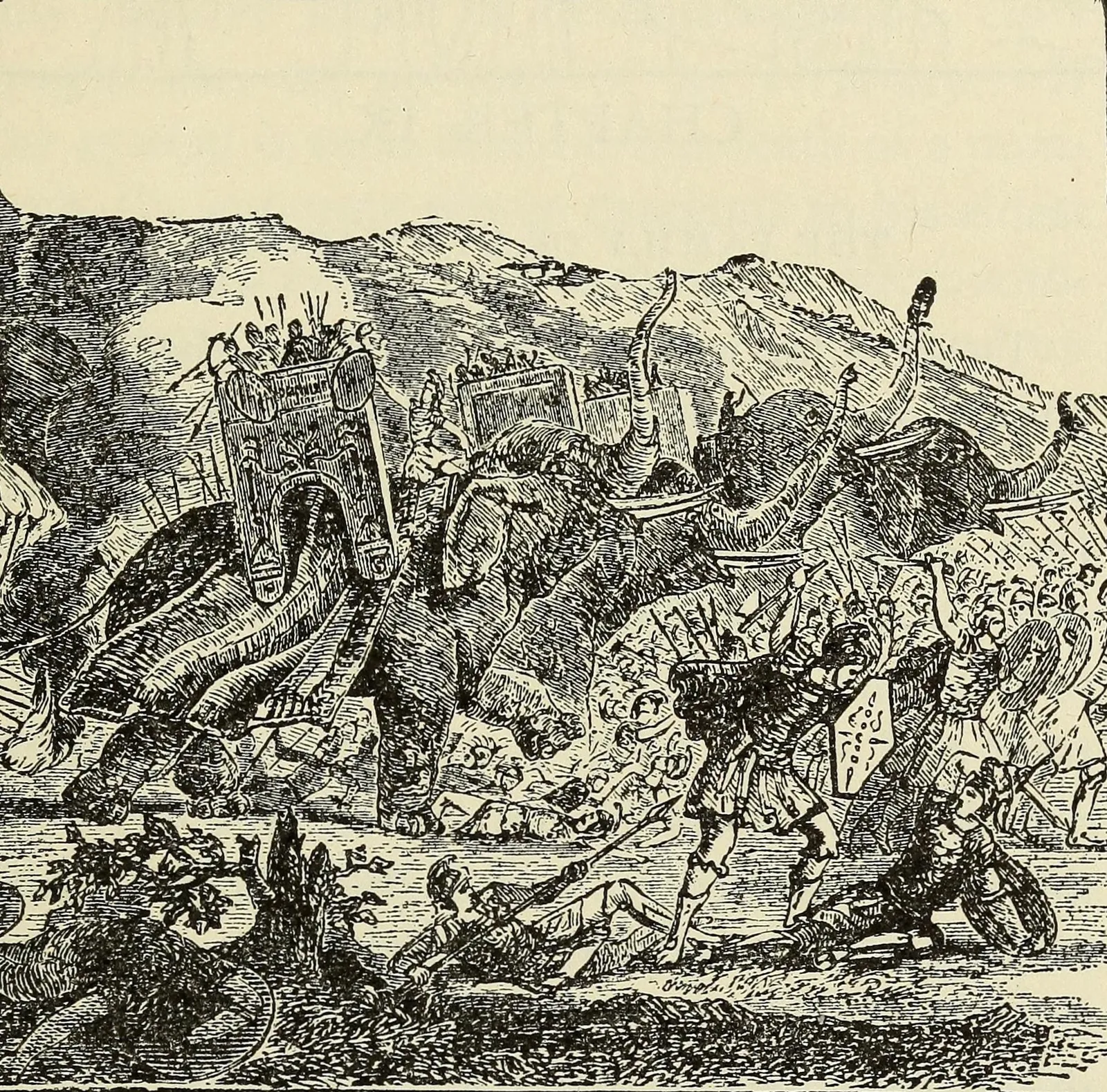
the most feared animal of antiquity was not a man with a sword but a mountain of armoured flesh that advanced at a walk and broke any human formation by the sheer terror it sowed. rome had met the war elephant five years earlier, at heraclea, and had suffered for it. in 275 bce, at the gates of a small samnite town called maleventum, she finally learned how to turn the beasts around. and she did it in the cruellest way imaginable: by making the animals the weapon that would tear their own master apart.
the master was pyrrhus, king of epirus, the finest general of his generation and a distant kinsman of alexander the great. he had landed in italy in 280 to defend the greek city of tarentum, and had won his first battles at so ruinous a price — so many officers dead for every victory — that his name was fixed forever to the idea of a triumph that bankrupts the victor. then he let himself be distracted: he crossed to sicily to make war on carthage, lost three years and the goodwill of the sicilian greeks there, and returned to italy worn down, with fewer men and less money. he still had his phalanx — the bristling wall of five-metre pikes he had inherited from alexander’s successors — and he still had his elephants. but he no longer had any room to fail.
facing rome stood manius curius dentatus, a consul of humble birth who embodied the frugal ideal the republic loved to tell about itself: the ploughman turned general, the man who would rather command those who had gold than have gold himself. his tactics were not heroic but cold and geometric. frontinus, in his stratagemata, makes it plain: curius understood that pyrrhus’s phalanx was irresistible when deployed in open ground, so he took care to fight on narrow, broken terrain, where that compact wall of spears stumbled over itself and got in its own way. he did not try to beat the greek machine; he tried to deny it the space it needed to work.
the battle was decided in the chaos. pyrrhus attempted a night march to take the roman camp by surprise, but — plutarch tells us — his torches went out in the woods, his columns lost their way, and at dawn they arrived exhausted and in disorder. curius came out after them, scattered them, and captured a few elephants in the confusion. when the beasts’ charge pushed him back toward his own palisade, the camp guards came down from the ramparts and began driving javelins into those enormous flanks. and here is the detail roman memory would never forget: wounded and maddened by the pain, the elephants wheeled about and charged back into pyrrhus’s own ranks, sowing disaster in his rear. two were left dead on the field; eight were taken alive when their indian mahouts surrendered.
pyrrhus’s ultimate weapon ended by trampling his own army.
now the historiographical nuance, which it is best not to skip. popular retellings — and the very script from which this page springs — tend to dress beneventum up with burning carts and torches plunged into the elephants’ eyes. but that image does not belong to this battle. the spiked carts and the grapples wrapped in flaming tow are described by dionysius of halicarnassus for asculum, in 279, not for maleventum. at beneventum the sources — plutarch, dionysius, cassius dio — speak of javelins, not fire, and of an almost novelistic episode: a wounded baby elephant that trumpeted in pain, its mother who broke the formation to come to its aid, and the contagion of panic that dragged the whole herd with it. it is worth keeping the two apart. the “fire” of the title is poetic licence for the blaze of fear, not a fact; what truly burned was the animals’ nerve, not their hide.
modern historians debate the scope of beneventum: some read it as an indecisive day, almost a draw, rather than a crushing defeat. pyrrhus still kept a substantial army, and he withdrew as much from the financial exhaustion of years of campaigning as from what happened on the field. with no elephants, no money and no allies, pyrrhus packed his bags. he left a garrison at tarentum and returned to greece, to die a few years later in a street brawl at argos, brought down by a roof tile flung at him by an old woman from a rooftop: an end as absurd as his victories had been pyrrhic. tarentum would fall in 272, and with it the last independent greek state in italy. rome now controlled the whole peninsula south of the po, and for the first time a fully fledged hellenistic power, heir to alexander, had been driven from the battlefield by that provincial town in latium. the greek mediterranean took note.
the town itself kept the memory in its name. the samnite maleventum — which to a latin ear sounded like “ill omen”, though its original root was surely pre-roman and innocent of that pun — was reborn as beneventum, “good omen”, when rome planted a colony there in 268. the change was the work of the superstitious colonist rather than a deliberate monument to curius dentatus, but the coincidence is perfect and history kept it: the square of the ill event came to be called that of the good outcome, right where the last attempt of a greek king to halt rome had been broken. the elephants that crossed the sea to terrify the republic ended up, without meaning to, announcing that the republic no longer had a rival in italy.