

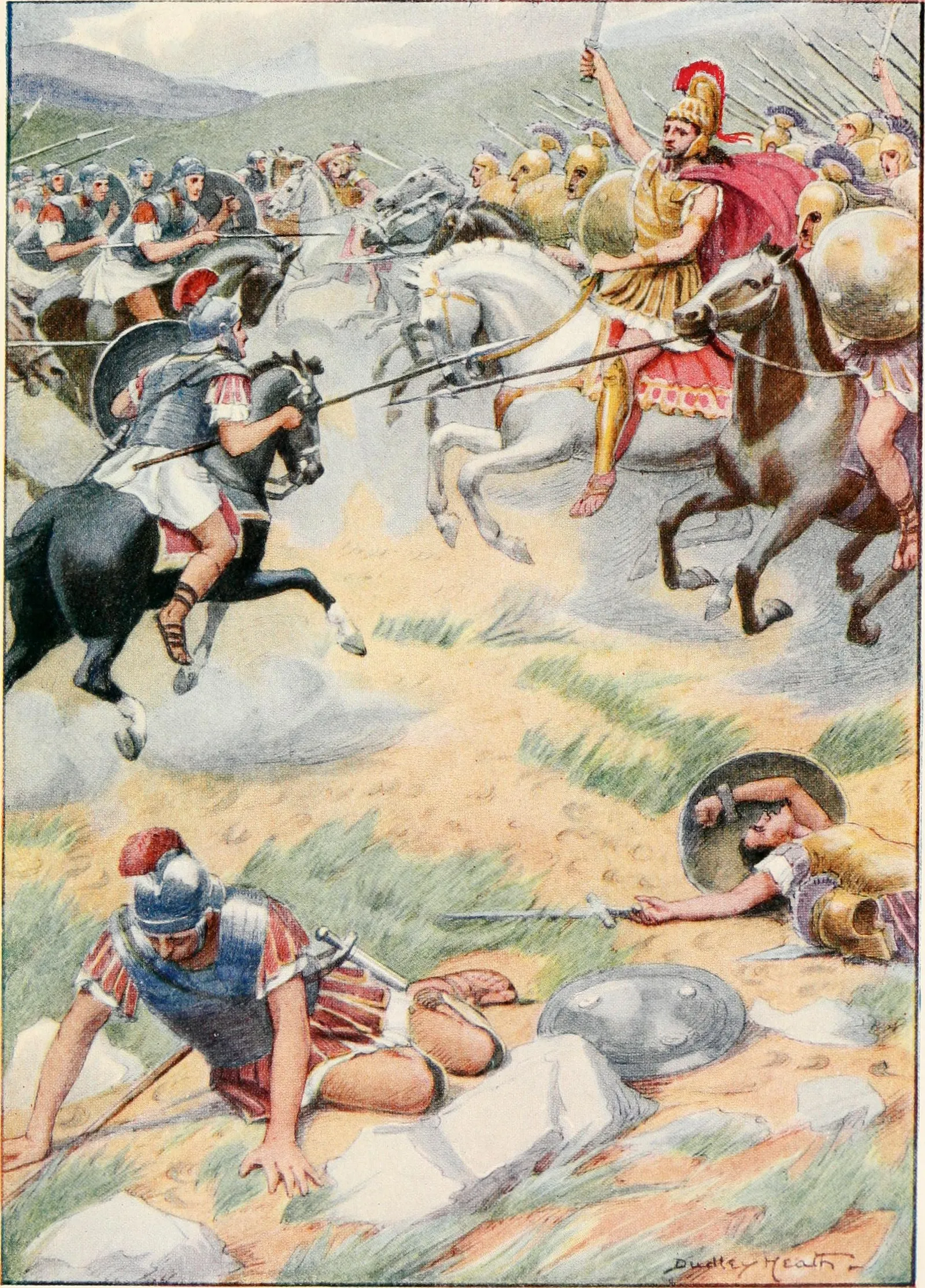
imagine having trained your whole life to kill at close quarters, with the short sword, looking into the eyes of the man you are about to split open, only to discover on the day of battle that between you and him rises a wall of six-metre spears you cannot get through. that is what happened to the roman legions in the summer of 280 bce, on the banks of the river siris, on the plain of heraclea. it was the first time rome faced an army built in the greek fashion, and the first time in her history that she saw elephants.
the foe was no city of philosophers. after the tarentum incident — the roman fleet sunk in the gulf and the humiliated embassy that precipitated the war — the tarentines had emptied their coffers to hire the most feared soldier of fortune in the mediterranean: pyrrhus, king of epirus, distant cousin of alexander and a professional soldier. he landed in italy with a professional army. the ancient figures waver, but the tradition plutarch preserves speaks of some twenty-five thousand men and twenty war elephants brought from the east, asian beasts no italic had ever laid eyes on. facing him, the consul publius valerius laevinus drew up the legions according to the system that had made rome great: the maniple, a lattice of small units that could open, close and manoeuvre like a flexible chessboard.
the clash was history’s first contest between two opposing military doctrines. before the maniple rose the macedonian phalanx: tight ranks of soldiers gripping the sarissa in both hands, a pike of nearly six metres on a cornel-wood shaft tipped with iron. five points jutted ahead of every front-rank man, forming a continuous hedgehog. plutarch tells that the line gave way and re-formed seven times, so the image of the roman simply skewered beyond hope is a simplification: there was real fighting, back and forth, for hours. but the geometry worked against rome. wherever the phalanx held its front closed, the sword had no one to reach.
the phalanx won the frontal push; the problem, for rome, was getting close enough to touch it.
with the infantry locked and no decision in sight, pyrrhus played his secret card. the elephants advanced upon the roman flank, and the effect was instant: the horses of the republican cavalry, which had never smelt nor heard anything of the kind, bolted and fled, dragging their riders away even before they neared the beasts. with the cavalry broken, pyrrhus’s heavy thessalian horse charged the disordered formation and swept the field. the romans would afterwards call those animals luca bos, “lucanian oxen”, because there, in lucania, they had first seen them — pliny the elder preserves the term in his natural history. pyrrhus was left master of the plain.
the scene that closed the day is the one that made the battle memorable, and it deserves careful attribution: it is told not by plutarch but by florus, who wrote more than three centuries later with a taste for the moral. according to his account, pyrrhus walked the field among the corpses and noticed that every dead roman bore his wounds on the chest, none on the back; they had fallen face forward, sword still in hand and the fury still drawn on their faces. out of that astonishment florus made the line the king never confirmed: with an army like this, he is said to have declared, he would conquer the whole world. the anecdote is more literature than chronicle, one of those vignettes with which the ancient authors dignified rome by placing the praise in the enemy’s mouth. but it points to something real that pyrrhus would not take long to verify.
here is the historiographical nuance worth not skipping. almost everything we know of heraclea comes from late and discordant sources: plutarch writes nearly four centuries later, leaning on hieronymus of cardia — a contemporary of pyrrhus, but lost save in fragments — and set against dionysius of halicarnassus, who gave different figures. the roman dead range between hieronymus’s seven thousand and dionysius’s fifteen thousand; pyrrhus’s losses, between four thousand and thirteen thousand. neither the exact number of elephants nor the precise size of the armies stands firm. what does withstand the criticism is the skeleton: at heraclea, for the first time, the legion clashed against the phalanx and against the elephants, and lost. the rest — the stained toga, the lucanian oxen, the wounds on the chest — is the wrapping with which rome chose to remember her defeat.
and yet pyrrhus had won the wrong field. counting his own dead, he saw that among them were his veterans and officers, professional mercenaries impossible to replace so many miles from epirus, whereas rome could vote a fresh levy in the forum and replace her fallen with peasants and allies bound by law. the king had just discovered that his enemy did not count battles, but reserves. the following year he would win again at asculum, and bleed again, until he unwittingly coined the expression that would make him immortal: one more victory like that, and he would be lost. heraclea was no roman defeat; it was the first warning that rome could not be beaten by winning her a single battle.