

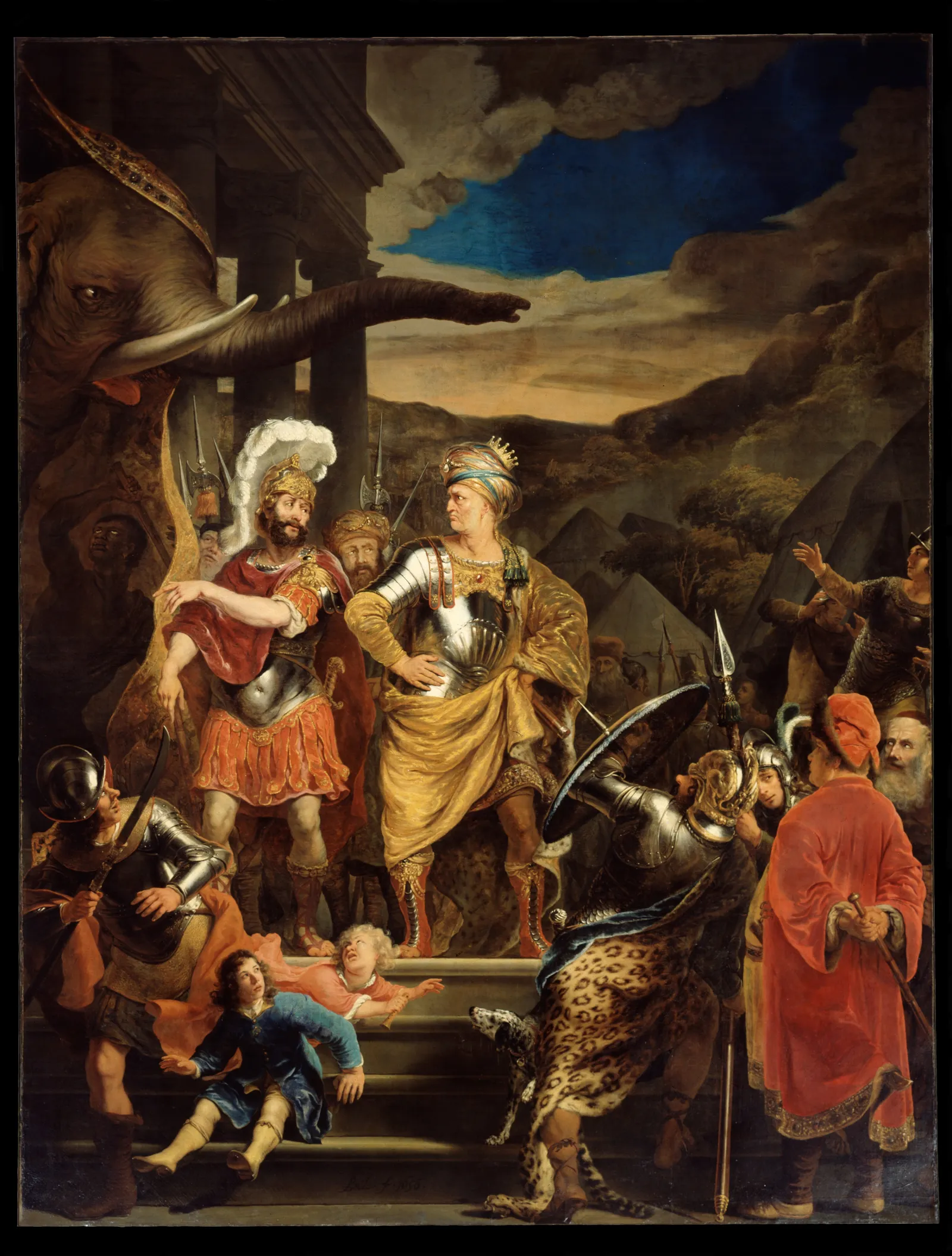
when an enemy will not be beaten on the battlefield, one last strategy remains: find out his price. that is what pyrrhus of epirus attempted — the greek king who had bled rome at heraclea and at asculum without managing to break her — when he received in his camp a roman envoy by the name of gaius fabricius luscinus. the king came bearing gold, elephants and all the pomp of the hellenistic east. the roman, so tradition has it, brought only one uncomfortable idea: that there are men who are not for sale.
it is worth setting the scene, because popular retellings tend to boil it down to a duel of clever lines and forget the war that surrounded it. pyrrhus had crossed the adriatic to defend the greek city of tarentum and had run into a new adversary, the manipular legion: he beat it twice — at heraclea and at asculum — at a cost so ruinous that from those days was born the expression “pyrrhic victory”. worn down and far from home, the king sought through diplomacy what arms would not grant him, and in that tug-of-war of embassies and prisoner exchanges fabricius appears. the ancient chronology muddles the journeys: plutarch ties the episode of the gold to the embassy of 280, after heraclea, though the figure of fabricius looms above all over the year of his second consulship, 278.
fabricius was no noble by birth. he belonged to an obscure family with no consular ancestors, a novus homo who had reached the very summit of the magistracy on his own merit in a republic where lineage was almost everything. centuries later, another new man — cicero — would make him his patron saint: the proof that virtus could force its way through without a family tree. fabricius was consul twice, in 282 and 278, and censor in 275, and he dragged with him all his life a reputation for almost ostentatious poverty. that poverty was no flaw to be hidden: it was his credential. a man who wanted nothing was a man who could not be bought.
pyrrhus understood this and put him to the test. first, plutarch tells us, he drew him aside in private and offered him gold as a gesture of friendship and hospitality; fabricius turned it down without batting an eye. the following day the king tried psychological warfare. he hid his largest elephant behind a curtain — a beast the roman, plutarch says, had never seen — and, in the middle of the conversation, had the hanging drawn back: the animal raised its trunk over fabricius’s head and let out a terrifying bellow. the envoy turned slowly and, with a smile, told the king that neither his gold had moved him the day before nor did his beast frighten him now. the point of the reply was the heart of the whole anecdote: the mastery of his own desires made him freer, and therefore richer, than a king surrounded by treasure.
a man who desires nothing is a man who has no price.
but the most demanding test was neither the gold nor the elephant, and here tradition takes a turn worth more than any rebuff. some time later, a deserter — in some versions, pyrrhus’s own physician — presented himself to fabricius and offered to poison the king in exchange for a reward. it was victory served on a plate: the end of the war and of his most fearsome enemy without losing a single legionary more. fabricius had the traitor sent back, bound hand and foot, to pyrrhus’s camp, warning him of who surrounded him. cicero rescued precisely this gesture in the third book of the de officiis as the model case for his thesis: that what was truly useful for rome could never be parted from what was honest, and that to defeat by crime a rival with whom one disputed glory would have been a lasting dishonour. rome preferred to win late and clean rather than early and foul.
now the historiographical nuance, which is best not skipped. fabricius existed and held the magistracies that tradition attributes to him, but the fabricius we know is in large part a construction. the scene of the elephant behind the curtain is most probably a later invention — plutarch’s own account lets its character as an edifying anecdote show through — and the sentence about the gold and the beast has the suspicious tidiness of phrases polished by generations of rhetoricians. the late republic and the early empire needed a hero of frugality and incorruptibility set against the luxury they felt corrupting their present, and fabricius was moulded to that measure by authors such as cicero, valerius maximus or seneca. his value, like that of cincinnatus, was never archaeological but ethical: it matters less whether the curtain really fell than the fact that rome wanted to tell itself with a man like that inside.
the outcome has an irony of its own. pyrrhus, unable to buy rome or to terrify her, ended up leaving italy for good, and the republic fabricius embodied went on growing. the bitterness came later: the very generations that canonised the poor consul who refused a king’s gold would watch their political class sink, two centuries on, into a corruption without bottom. when an elite needs to repeat to itself so often the story of an unbribable man, it is usually because it can no longer find one anywhere around it. fabricius survived in roman memory not as what rome was, but as what she feared she was ceasing to be.