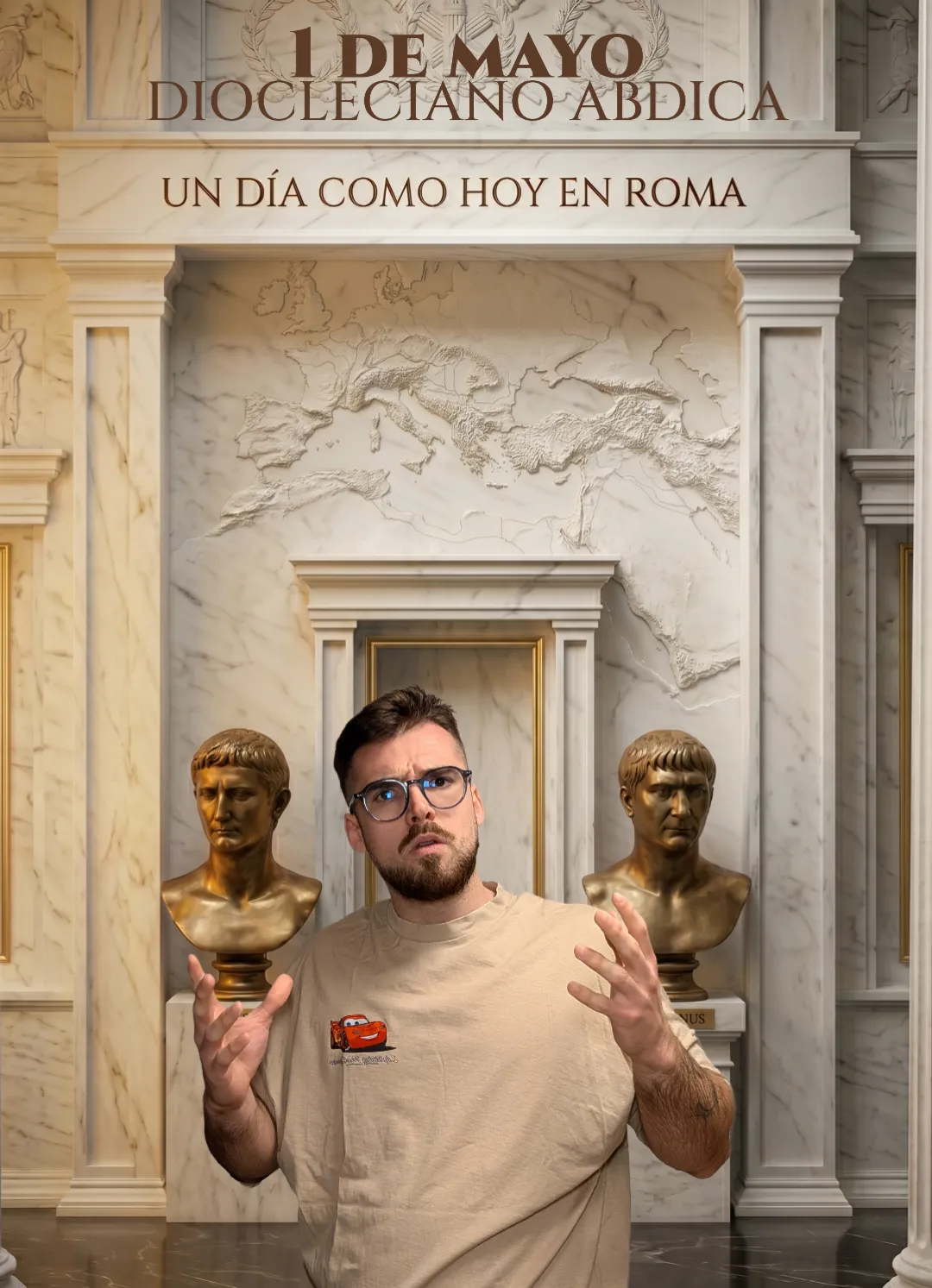

the man with the most power on the face of the earth held absolutely everything in his hands, and decided to give it up to retire to his estate and plant cabbages. on 1 may 305 ce, on a hill outside nicomedia, diocletian took off the purple cloak before the army and became the first roman emperor to renounce the throne of his own will.
to measure the rarity of the gesture one has to understand where rome was coming from. diocletian had inherited an empire on the brink of disintegration: the so-called crisis of the third century, half a century of chaos in which dozens of emperors succeeded one another, nearly all assassinated, while the borders crumbled and the economy collapsed. that a sovereign died in bed was already a rarity. diocletian, a soldier of humble origins from present-day croatia, pulled the state out of that abyss through brutal reforms.
his programme was a refoundation. he abolished the old augustan fiction that the emperor was just another citizen, a princeps, “the first” of the state, and established the dominate: a sacralised regime in which one had to kneel and kiss the hem of his robe. he multiplied the army and the bureaucracy, reorganised the provinces and tried to halt inflation with an edict on maximum prices that failed spectacularly. and, above all, his reign carried the last and, in the east, most systematic persecution against the christians, the “great persecution”, which his official record never recalls and which the christian lactantius made sure was not forgotten.
if they could see the vegetables i grow with my own hands, they would never ask me to return to that hell.
his most original move was to divide power instead of accumulating it. aware that one man could not defend the rhine, the danube and the east all at once, he designed the tetrarchy: two principal emperors, the augusti, and two subordinate heirs, the caesares, ruling each quadrant of the empire. it was a system thought out to guarantee orderly successions by merit and not by blood, and so that power would not hinge on the survival of a single man.
and then he did the unthinkable: on 1 may 305 he persuaded a reluctant maximian —bound by an oath sworn in the temple of jupiter— to abdicate alongside him, and retired to his vast fortified palace at spalato, present-day split. the version that coercion was involved comes from lactantius, hostile to the tetrarchy, and is disputed. years later, when the tetrarchy began to unravel into civil wars because the heirs refused to respect the partition, they begged him to take the helm again. his reply, recorded by tradition, is one of the most famous lines of antiquity: that if they could see the vegetables he grew with his own hands, they would not ask such a thing of him.
history, mind you, proved him right only halfway. his system outlived him by barely a handful of years: the tetrarchy collapsed almost immediately and from those wars would emerge a single victor, constantine, who would return to hereditary power and dismantle much of his work. but diocletian had achieved something none of his predecessors in that terrible century had: stem the decline, rebuild the state and, above all, outlive his own absolute power. he died in peace in his vegetable garden, watching the world he had saved tear itself apart without him.