

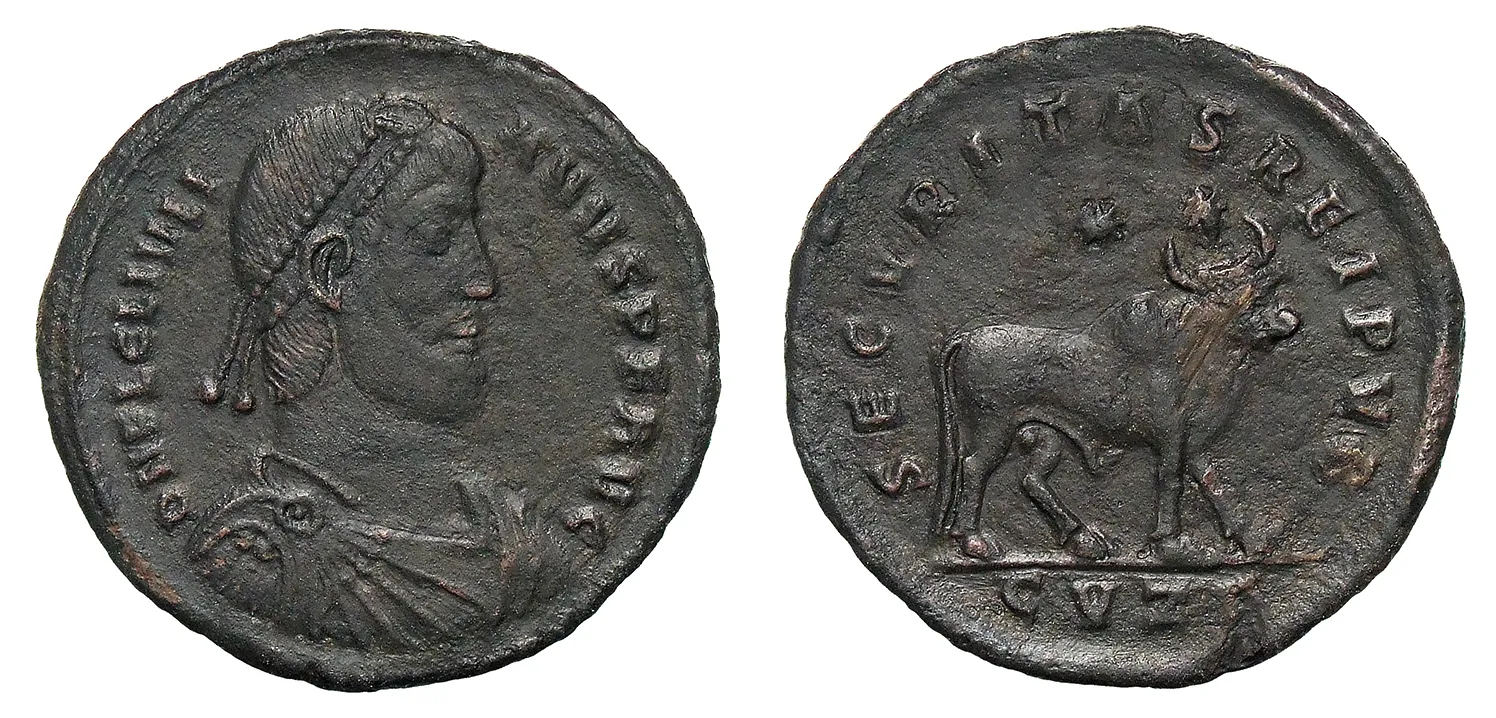
the last serious plan to give the roman empire back to its old gods was not undone by a miracle, but by a javelin whose origin no one ever managed to explain. on 26 june 363, somewhere in the tigris valley south of present-day samarra, the emperor flavius claudius iulianus —julian, whom christian posterity would brand “the apostate”— fell from his horse with his side laid open during a retreat that had already turned into an agony. he was thirty-one years old.
julian was an oddity on the throne: an intellectual of neoplatonic training, raised in the shadow of constantine’s christian family and later drawn away from christianity in secret. when he came to power in 361 he did not persecute the christians with prisons and pyres —that script would come later— but with bureaucracy. he reopened the temples, restored the public sacrifices, tried to give paganism an organised priestly hierarchy in imitation of the church, and stripped christian teachers of the right to teach the classics. the idea was subtle: not to crush the new faith, but to give the old pantheon back the institutional machinery that had kept it working for a thousand years.
to secure that project he needed the prestige that only war could give. in the spring of 363 he led an enormous army against the sasanian empire, marched down the euphrates and reached the gates of ctesiphon, the persian capital. but he could not take it. with his supply lines overstretched, the heat relentless and king shapur ii refusing to give pitched battle, julian ordered the retreat towards roman territory. it was then that the campaign fell apart: the persian cavalry harried the column without respite, hunger pressed, and every day’s march cost men. ammianus marcellinus, who served as an officer in that army and is therefore an eyewitness, recounts those days with the dry precision of a man who lived through them.
on 26 june, one of those skirmishes broke out at once in the vanguard and in the rearguard. julian, according to ammianus, galloped out to reorder the lines in such haste that he did not stop to put on his cuirass. in the confusion, a cavalry lance grazed his arm, pierced his ribs and lodged in the lower lobe of his liver. they carried him to the imperial tent, where his physician —the celebrated oribasius of pergamon— tried to suture the wound. it was useless: he died that same night.
ammianus, who was there, wrote that the javelin came “from no one knows where”. the honest phrase of a witness became the blank space that each side filled to its own taste.
now the historiographical nuance, which is precisely the heart of this story. who threw the javelin? ammianus, the most reliable source and the only eyewitness, confesses that he does not know: incertum unde, he wrote, “from no one knows where”. and over that void a propaganda battle was fought at once. pagan authors such as zosimus put it down to a persian blow or, worse, to a betrayal; the rhetor libanius, julian’s friend and panegyrist, went so far as to maintain that the killer was a christian from his own ranks, indignant at the emperor’s devotion to the gods. later christian historiography —sozomen among them— gladly took up that version and turned it into divine punishment. others pointed to a saracen arab auxiliary in persian service. the truth is that none of those attributions can be proved: the javelin remains anonymous, and it is best to resist the temptation to assign it an owner the sources do not authorise.
what is documented is the day after. with julian dead and the army trapped in enemy territory, the generals did not summon jupiter: at dawn on 27 june they elected as emperor jovian, an officer of the guard and a christian. cornered without provisions, jovian accepted from shapur ii a humiliating peace —a thirty-year truce in exchange for five provinces across the tigris and fortresses such as nisibis and singara—, terms that ammianus himself condemned as a disgrace. the famous dying phrase that tradition puts in julian’s mouth, “you have conquered, galilean”, belongs to a much later christian legend and does not appear in the contemporary sources: it is theology disguised as chronicle.
with julian the constantinian dynasty came to an end and, with it, the last realistic chance that an emperor would give paganism back the apparatus of the state. the pagan aristocracy of the west would keep its influence and altars for generations, but it would never again hold the throne or the imperial programme. it is one of the great ironies of late antiquity: the man who wanted to restore the gods with laws, budgets and organisation charts ended up handing christianity its best story, that of a persecutor struck down by an invisible hand. the chance of a skirmish —an unfastened cuirass, an unsigned lance— weighed more in the history of europe than all his edicts.