

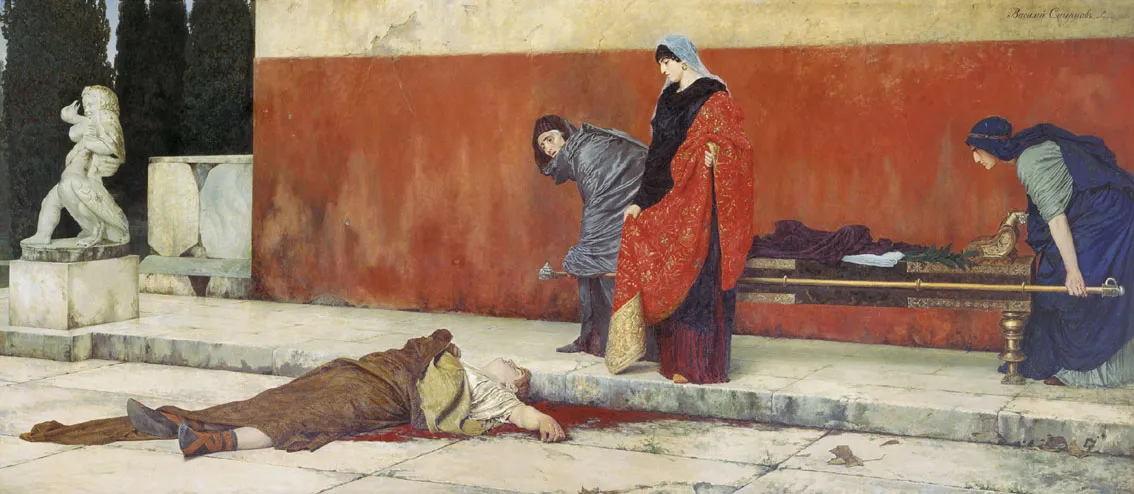
the last descendant of augustus did not die on a throne but in the cellar of a borrowed villa, some six kilometres from rome, with the voice of the praetorian cavalry drawing nearer along the road. on 9 june in the year 68, nero — thirty years old, the fifth and last emperor of the julio-claudian dynasty — drove a dagger into his throat. with that clumsy, terrified gesture the line that had ruled rome since caesar went out, and something far more dangerous was set in motion.
the fall was swift and it was built from outside. the legions of hispania had risen in favour of galba, an old governor of tarraconensis, and the rebellion that had begun in gaul with vindex caught fire everywhere. but the sentence did not come from the front; it came from nero’s own house. the praetorian guard, the elite corps paid precisely to protect him, let itself be bought. its prefect, nymphidius sabinus, promised the soldiers a reward in galba’s name, and the guard abandoned the emperor. without praetorians there was no empire to defend. nero woke one night in the servilian gardens, to which he had moved to prepare his flight, and discovered that the sentries had gone.
what drove him out of rome was the desertion of the guard. he left the city almost barefoot and in a tunic, with barely four companions, towards a villa offered to him by his freedman phaon, between the via salaria and the via nomentana. already hidden there, a courier brought him the news: in rome the senate — which for fourteen years had voted him honours — had declared him hostis, a public enemy of the state, and was hunting him to punish him more maiorum, “in the way of the ancestors”. when nero asked what that archaic formula meant, suetonius tells us he was told that the condemned man was stripped, his neck clamped in a wooden fork — the furca — and beaten to death with rods in public.
the body that guarded the divine blood of augustus ended up hidden in the servants’ quarters of a former slave, digging his own grave with his hands.
inside, while he ordered a tomb cut to his measure and water and firewood gathered for the corpse, he uttered the phrase that has pursued him for two thousand years: qualis artifex pereo, “what an artist dies in me”. still he hesitated, unable to sink the blade alone. only when he heard the gallop of the horsemen sent to take him alive did he resolve to act: with the help of his secretary epaphroditus — his a libellis, the man who handled his petitions — he turned the dagger to his throat. a centurion burst in pretending he had come to save him; nero managed to murmur “too late” and “this, at least, is loyalty”, and expired with bulging eyes, suetonius says, in a manner that horrified all who saw it.
it is worth qualifying what that final phrase carries with it. qualis artifex pereo comes from suetonius, who wrote half a century later and had a weakness for the well-rounded anecdote; no witness could have recorded it in that room, and very probably it already circulated as a maxim distilled from the character — the emperor who fancied himself a singer and charioteer before a caesar. the same goes for almost the whole account of his last day: it depends in essence on suetonius, hostile to nero and fond of the theatrical detail. what is firm is the date, the place on the outskirts, the praetorian desertion and the assisted cutting of the throat; the stage colour is best read for what it is, a good story told by an enemy. and there is an irony the tradition underlined: 9 june was also the anniversary of the death of claudia octavia, his first wife, whom he himself had ordered executed six years earlier.
the true discovery of that day was not the dead man but what his death laid bare. tacitus put it with unsurpassable coldness: with nero’s end the arcanum imperii had been divulged, the secret of power — posse principem alibi quam romae fieri, that an emperor could be made somewhere other than rome. for a century the principate had rested on the fiction that only the blood of augustus legitimised command. galba, proclaimed by his troops in hispania, proved that an army and a treasury to pay it were enough. the following year, 69, four men fought over the throne by the sword, and from then on emperors would be born ever farther from the curia and ever closer to the camps. nero was the last roman to reign by birth; those who came after reigned because the legions, not the republic nor the gods, decided it so.