the master of the most powerful world of his time reached the throne by no merit, no patrician blood, not even by age: he reached it because his grandmother bought a legion. on 8 june in the year 218, on a plain near antioch, the troops loyal to the severan family undid the emperor macrinus, and the crown fell not to a grey-haired veteran but to a boy of fourteen who was, moreover, the priest of a syrian god rome did not know.
his birth name was varius avitus bassianus, but he would pass into history as elagabalvs — heliogabalus in its latinised form — not for himself but for his god. his mother’s family, the emesenes, held the hereditary priesthood of elah-gabal, “the god of the mountain”, worshipped in the syrian city of emesa. on ascending the throne the boy adopted the imperial name marcvs avrelivs antoninvs: the very one caracalla had borne, so as to claim to be his son and bind himself to the legitimacy of the dynasty. the political machinery, however, was not his. it was contrived by his grandmother, julia maesa — sister of julia domna, the wife of septimius severus — who financed the rebellion out of her own purse and pushed the iii gallica legion to proclaim him. on the field of antioch itself it was not the boy who commanded: it was gannys, his tutor, while his mother and grandmother rode among the ranks to halt the rout when macrinus’s praetorians came close to breaking the line.
the western aristocracy expected the usual thing: a young consul, malleable, manageable. what arrived was something else. heliogabalus did not leave his priesthood in the east to govern in rome; he brought his priesthood to rome. he arrived with the baetyl of emesa on his back, a huge conical stone of a matte black, of probable meteoric origin, which he worshipped as the very embodiment of his god. herodian describes it with bewilderment: a rock revered “as fallen from heaven”, with reliefs and protrusions in which the faithful claimed to see, they said, a crude portrait of the sun. the emperor had it paraded through the capital in a chariot drawn by six white horses while he walked backwards, never losing sight of it, and minted coins with that same stone mounted upon the quadriga. it was no whim: it was state theology.
the real clash was not one more exotic stone — rome had imported sacred meteorites before, such as that of cybele — but what came afterwards. around the year 220, by then installed in rome, heliogabalus took the step no eastern divinity had dared to take: he declared his elagabal supreme god of the empire, above capitoline jupiter. he raised a colossal temple on the palatine, the elagabalium, to house the stone, and transferred to it rome’s most sacred relics. he forced the senators to attend rites according to the tradition of his emesene god. and he married a vestal virgin, aquilia severa, an act that for any roman amounted to a capital sacrilege. the mos maiorum, the custom of the ancestors on which the whole identity of the city rested, was altered by an adolescent formed in syrian traditions.
rome had defeated a usurper only to discover that the prize was a foreign god seated upon the palatine.
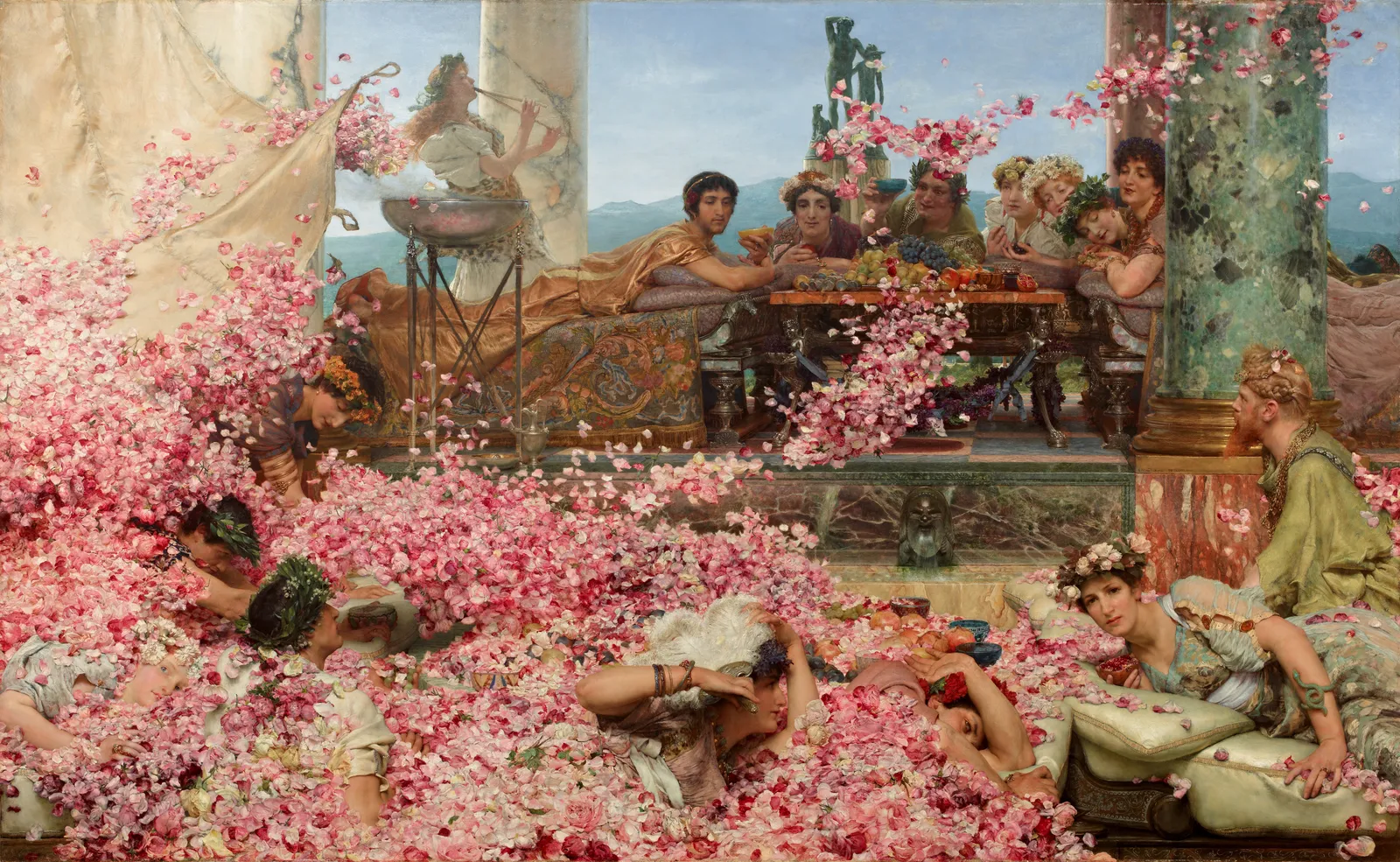
now the historiographical nuance, which it is best not to skip, because almost everything we “know” of heliogabalus is suspect. the most famous stories — that he prostituted the imperial dignity, that he sold himself in palace brothels, that he wanted to appoint charioteers and dancers to the magistracies, that he smothered guests under tons of petals — come above all from cassius dio, a contemporary senator who wrote hostile to the regime and under the reign of the cousin who replaced him. it was not exactly “propaganda paid for by the senate”, as popular accounts simplify it: it was something subtler and more effective, the reckoning of a humiliated elite that had every interest in whitewashing the coup that brought him down. historians like martijn icks or mary beard handle that material with tongs: it is probably, in good part, retrospective defamation. what truly offended rome was not the emperor’s bedchamber but his religion — and that much is documented in the coins and in the stones.
the ending confirms it. the empire was not tottering because of a boy’s eccentricities, but because of the military instability that had set on the throne anyone capable of paying a legion. and the one who saw the danger was, once again, julia maesa: the same grandmother who had manufactured him realised that her grandson’s fanaticism was alienating the praetorian guard and endangering the whole family. her solution was cold and dynastic: she manoeuvred to elevate the other grandson, the future severus alexander, and let the guard do the rest. on 11 march 222, the praetorians murdered heliogabalus along with his mother, dragged their bodies through the streets and tried to throw them into a sewer. he was eighteen. the immense empire that the legions of syria had handed him was wrenched away by his own guard barely four years later, and the black stone was returned without ceremony to emesa, from which it should never have left.