
a whole army can be destroyed without a single arrow being loosed. a mountain and a little cunning are enough. in 321 bce, in the thick of the second war against the samnites, the romans learned this in the worst possible place: a narrow pass of the apennines to which tradition gave a name that for centuries meant dishonour, the caudine forks —furculae caudinae—, in campania, near the town of caudium. scarcely any blood was spilt there, and precisely for that reason the wound proved incurable.
two consular armies, commanded by titus veturius calvinus and spurius postumius albinus, were pursuing an elusive enemy. confident, they pushed into a tight defile believing they were cutting their way towards the front. when they reached the far end they found the exit blocked by a wall of felled trees and boulders. they turned about to retrace their steps and discovered that, at their backs, the samnites had sealed the entrance too. they were bottled up in a box of stone, without provisions or water, with no enemy to charge and no ground over which to flee. the plan was not gaius pontius’, the samnite chieftain’s, but the result of a perfect ambush: to win the war by shutting the rival into a trap from which the only exit is starvation.
what happened next is, in livy’s account, one of the most celebrated moral scenes in roman history. when the trapped romans asked for terms, gaius pontius consulted his aged father, herennius pontius, an old sage renowned among the samnites. the father gave him two opposed counsels and no middle ground: either release every roman safe and sound, asking for nothing, to win their friendship for ever; or wipe them out to the last man, to cripple rome for a generation. any intermediate solution —humiliating them and letting them go— would be the worst of all. the line livy attributes to him became a proverb: the roman stock, he warned, does not know how to keep still after a defeat.
gaius pontius wished neither to forgive entirely nor to kill entirely, and chose precisely what his father had counselled against: humiliation.
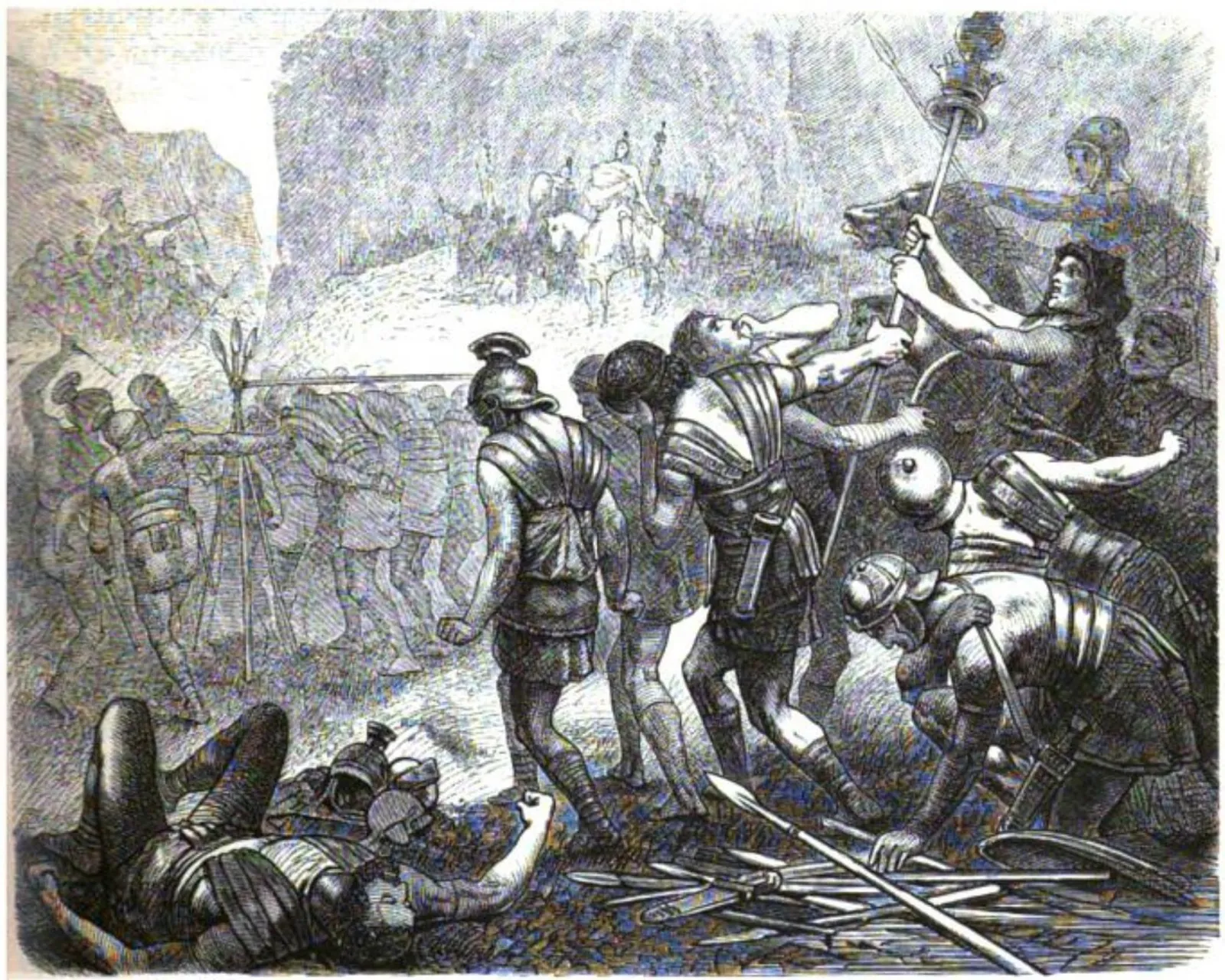
instead of the sword, pontius imposed the affront. the romans had to surrender their arms, their horses and almost all their clothing, and to pass, one by one and half-naked, stooped beneath the iugum: two spears planted in the ground and a third tied horizontally above, so low that it forced a man to bend double. it was the very rite by which rome herself had humiliated her vanquished enemies, now turned back against her. first passed the consuls, then the officers by rank and at last the rank and file, while the samnites, armed, surrounded them with jeers and insults. for a roman this was not losing a battle: it was losing face before the enemy, returning alive but disgraced. the column marched back towards rome in silence, avoiding the towns, entering the capital by night so that no one might see the shame.
the true blow, however, was legal and came afterwards. to escape the trap, the consuls and officers had pledged their word in a sponsio, a personal commitment to peace guaranteed by six hundred horsemen handed over as hostages. but rome found a loophole in that commitment: a sponsio did not carry the force of a true foedus, for it had been ratified neither by the people nor by the fetiales, the priests charged with treaties. back in rome, the senate declared that the pact bound not the republic but only those who had sworn it, and the whole weight of the shame fell upon the consuls who had pledged their word to save the rank and file. and then spurius postumius proposed a way out as twisted as it was roman: that he and the other guarantors be handed over, bound and naked, to the samnites, so that the dishonour might fall upon their persons and rome be cleansed of the oath. gaius pontius refused to accept the surrender: he understood it was a trick to annul the agreement and resume the war. he was right.
a historiographical nuance is in order now, and it weighs especially heavily here. almost everything we know comes from livy, who wrote three centuries later out of an annalistic tradition bent on turning defeat into moral lesson. the figure of forty thousand men trapped is his, and is almost certainly inflated: the soberer reckoning of modern scholarship, following students such as e.t. salmon, reduces two consular armies to some twenty thousand. the scene of herennius’ counsel has too neat a finish, the polish of a contrived moral, and it has been noted that livy’s geography recalls, suspiciously, the tales told of alexander the great. what is reliable is the essential: that in 321 a roman army was surrounded without a fight, that it passed under the yoke and that rome repudiated the pact. the moralising embroidery is probably later; the humiliation, real.
that, in the end, was the calculation that failed gaius pontius. his father had told him: with the romans, you either win them over entirely or annihilate them entirely; to humiliate them without destroying them is to sow a vengeance. and that is exactly what happened. rome did not forget the caudine forks; she turned them into a founding grievance, into the memory that justified never surrendering. when the reckoning came, it did not come with more swords alone. to strangle those mountains that had penned her in, rome would learn to tame them with stone and a straight line, laying down towards the south the first of her great roads. the bloodless affront of caudium ended up being, paradoxically, one of the lessons that most propelled her machinery of conquest.