

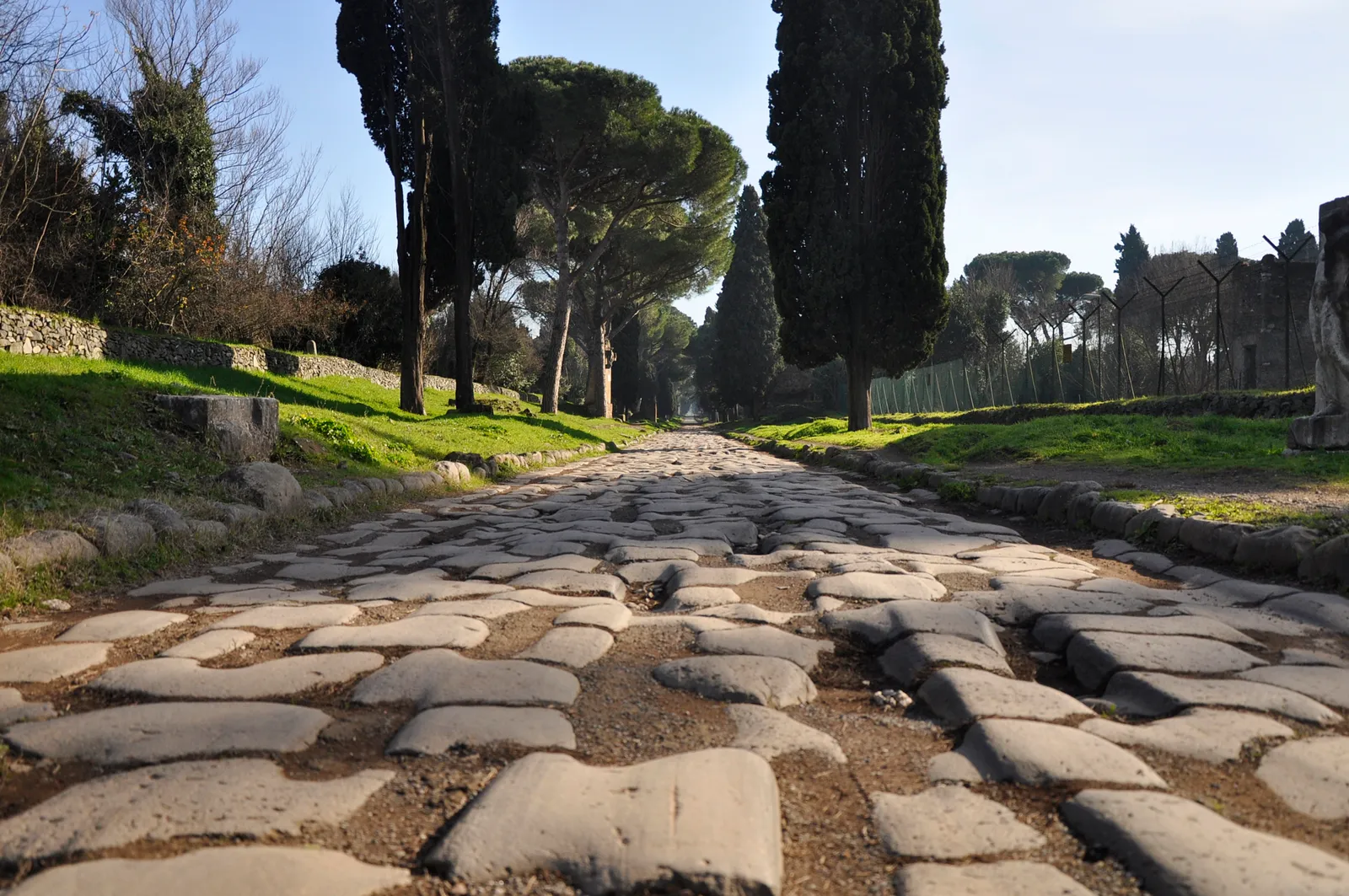
rome was slow to grasp that great wars are not won by better swords alone, but by roads that do not turn to swamp when it rains. it learned this the hard way in the mountains of the south, against the samnites, where its armies groped forward along muddy tracks. the answer was no new weapon nor some brilliant general: it was a road. in 312 bce a censor named appius claudius ordered a straight line of packed earth and stone laid from rome towards the front at capua, and with that gesture he inaugurated something no enemy of antiquity ever managed to match: logistics as an instrument of power.
the office from which he did it was no accident. the censor was responsible for the census, for public morals and, above all, for the great contracts of the state: the works paid for with public money. appius claudius used that lever to launch two simultaneous projects that changed the material face of rome — the via appia and the aqua appia, the city’s first aqueduct — both in the thick of the second samnite war. according to diodorus siculus, who wrote the bibliotheca historica nearly three centuries later, appius spent a good part of the state’s coffers on them. the figure, and the budgetary scandal that tradition attaches to it, are best taken with caution: they come from much later sources with a tendency to moralise.
the original route did not reach far by the standards of a future empire, but it was a feat for its time: from rome to capua, some one hundred and thirty-two roman miles — almost two hundred kilometres — in an almost stubborn straightness, cutting through hollows and marshes instead of skirting them. the decisive thing was not the line but the method: a base of levelled earth, layers of compacted gravel — the glarea — and a central camber so that rainwater ran off into the side ditches rather than pooling on the surface. a road like that did not soften under a storm, and along it tens of thousands of legionaries and their supplies could march at a brisk pace in any season, faster than any rival.
the empire did not begin with a victory, but with a roadbed that would not sink beneath the rain.
that was the real novelty. until then an army depended on weather and terrain as much as on the enemy; the via appia uncoupled rome’s advance from the mud. it turned the hostile geography of the south into a controlled corridor, allowed garrisons to be relieved, reinforcements to be brought up and grain to be moved at a rhythm that wrecked the adversary’s calculations. it was not a commercial highway dressed up as public works: it was born as a weapon. and it worked so well that rome extended it over the following centuries all the way to brindisi, its gateway to the eastern mediterranean, and copied it across all of italy until it had woven the network of roads that would hold the empire together.
now the historiographical nuance, which should not be skipped. the via appia photographed today — polished basalt slabs fitted together like a jigsaw — is not, for the most part, the road of 312 bce. the polygonal hard-stone paving is a later development: tradition places one of the great repavings with basoli, the blocks of volcanic lava, around 189 bce. the original road was first and foremost a via glarea, a gravel road; appius’s genius lay in the drainage and the compacted bed, not in a monumental paving that would arrive later. when diodorus describes it as “paved with solid stone”, he is portraying the road he knew in his own day, not the one opened under the censor. the risk here is to project the imperial monument back onto its humble military origin.
the man is just as freighted with legend. the cognomen caecus, “the blind”, did not accompany appius claudius during his censorship: the blindness came to him decades later, already an old man, and livy tells it as a divine punishment for having tampered with a sacred cult — one of those moral explanations with which the roman annalists ordered the chance of a life. blind or not, the same appius reappears in rome’s memory years afterwards, by then sightless, delivering the speech that rejected peace with pyrrhus: the image of the unbending old man who made himself. legend aside, what is solid in his biography fits in a few lines, and the via appia is the firmest of all.
the name that made it famous does not date from 312 either. it was the poet statius, around the year 95 of our era — more than four centuries later — who sang of it in his silvae as longarum regina viarum, “the queen of the long roads”. the epithet is imperial literature, not a founding inscription: posterity placed the crown upon it, not appius. and yet it fits. from that first line of gravel that refused to sink beneath the rain came the idea that would carry rome furthest: that an empire is not conquered by legions alone, but by the stubborn certainty that you can reach anywhere, rain or no rain, along a road that does not fail.