

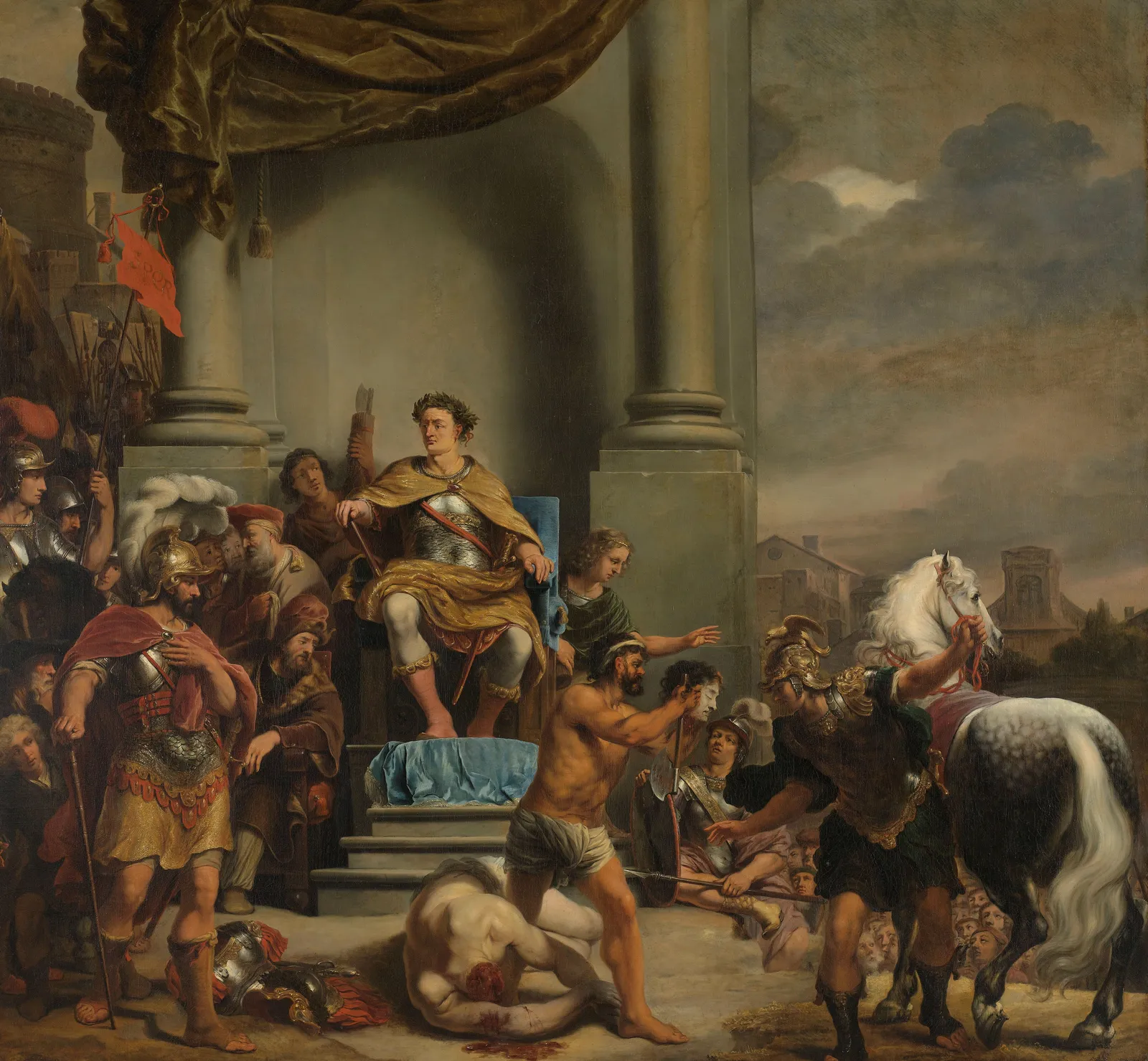
winning a fight against the enemy could cost you your head if you did it without permission. that, quite literally, is what happened to a young roman officer in 340 bce: he returned to camp with the bloodied arms of his rival, expecting an embrace, and his own father had him beheaded in front of the whole army. the father was the consul who gave the orders; the order he defended weighed, in his reckoning, more than blood.
the setting was the latin war, the conflict that pitted rome against the cities of latium that until then had been her allies. livy places the episode in the campaign in which the consuls titus manlius torquatus and publius decius mus led the legions against the latins, near vesuvius. the tension had an unsettling element: the two sides shared language, weaponry and formation, so that telling friend from foe amid the chaos of a skirmish was all but impossible. to keep cohesion from collapsing, the consuls issued a stern edict: no one was to leave his post to fight a latin in single combat, on pain of death.
the consul’s son, also named titus manlius, commanded a cavalry patrol that ranged out beyond the enemy camp. there the cavalry of tusculum lay posted, under geminus maecius, a horseman renowned for his lineage and his deeds. maecius recognised the consul’s son and challenged him aloud, so that it might be settled once and for all how far the latin outmatched the roman. the young man, stung by the dare, forgot his father’s edict and accepted. according to livy, in the charge manlius drove his spear between the ears of the enemy’s horse; the animal reared and threw its rider, and before maecius could rise the roman ran him through the throat. he stripped the dead man of his arms and rode back exultant, the spoils held high, to present them to his father.
go, lictor, bind him to the stake — and he did not rise from the platform while the blood gushed from the severed neck.
torquatus did not flinch. he turned his eyes away from the boy, ordered the assembly sounded and, before the legions drawn up in ranks, pronounced the sentence. his son had won, yes, but at the cost of the one thing that kept an army alive: obedience. either the authority of command was affirmed by his death, he said, or it was abolished forever by his impunity. he ordered the lictors to bind him to the stake and behead him on the spot, and he remained impassive in his place while the sentence was carried out. the son’s individual heroism, in the father’s reckoning, was a crack through which chaos might slip; and rome cared more for order than for the hero.
from that scene was born an expression the romans would repeat for centuries: the imperia manliana, “the orders of manlius”, a byword for an inflexible discipline that admits no exception, not even for one’s own blood. livy himself records that the consul’s harshness, besides appalling those present, stood as a model of severity for the generations that followed; and that his name was hated by roman youth as long as he lived. the lesson was brutal and deliberate: in the body of an army, the glory of one man does not make up for the danger of each soldier deciding for himself when and against whom to fight.
now the historiographical caveat, which it is best not to skip. the episode reaches us by a single substantial channel — the eighth book of livy — written more than three centuries after the events and from the annalists who preceded him. the story has the too-perfect shape of a moral exemplum, and that is no accident: the annalistic tradition tended to fix a single trait of character upon each great family, and to the manlii it assigned precisely a pitiless severity, to the point that their cognomen, imperiosus, meant “domineering”. scholars of single combat in rome, such as stephen oakley, read these formalised duels with caution, aware that the epic tradition polished them. the most prudent thing is to say that the event may have had a real core — an exemplary punishment for indiscipline in the thick of the latin war — but that the scene as we know it is shaped to enclose in a single image the roman ideal of discipline above all affection.
whether or not it happened exactly so, its worth was never archaeological but ethical. rome told herself that she would rather lose a hero than lose order, and chose as the emblem of that idea a father who held his gaze steady while his son was executed. in the same campaign, his colleague decius mus would carry that logic to the opposite and complementary extreme: if torquatus showed that the state could demand the life of the son, decius would show that it could also demand the life of the consul himself, offering himself in sacrifice to the gods to buy the victory. two faces of one and the same terrible coin — that of a republic which asked its best men to annihilate themselves for her sake.